

Best iPlum Alternatives in 2026 for Business Texting and Calling


iPlum has been a popular choice for solo professionals and small healthcare practices that need a second, HIPAA friendly phone line on their personal device. But as teams grow, add staff, or need deeper integrations, many businesses start looking for something else. This guide compares the strongest alternatives to iPlum in 2026, explains why people search for a replacement in the first place, and walks through exactly what to check before you switch.
Why Do People Search for an iPlum Alternative
iPlum works well for a single user who wants a second number with basic HIPAA safeguards. Most of the frustration shows up once a business needs more than that. Here are the reasons that come up most often in reviews and support forums.
Core features sit behind paid upgrades: Web calling, call recording, voicemail transcription, and toll free numbers are not included on the entry level plan. Businesses that assumed these were standard often find themselves paying for a higher tier just to unlock basic functionality.
Texting reliability complaints: Some users report messages that appear to send but never actually reach the recipient, with no clear failure notice. For a healthcare provider or a business that depends on text confirmations, a silent delivery failure can mean a missed appointment or a lost client.
A dated, click heavy interface: Several reviewers describe the app as clunky, with too many steps required for routine tasks like approving a number or updating a contact. Copy and paste is limited in some screens, which slows down anyone managing a high volume of conversations.
Limited team collaboration: iPlum was built around an individual user's second line, not a shared team inbox. There is no built in tagging, internal notes, or true multi user collaboration on the same conversation thread, which becomes a real limitation once a practice or company adds more than one or two people.
No desktop app and a capped group calling feature: Everything runs through the mobile app or a browser tab, and three way calling tops out at three participants, which is restrictive for teams that regularly hold small group calls.
Support is email only: There is no live chat or phone line for iPlum customers, so anything urgent has to wait for an email reply. Several reviewers note that support handles individual tickets fine but does not help with bigger picture account or compliance questions.
HIPAA compliance costs extra: The HIPAA compliant tier sits well above the base price, which some healthcare users see as a steep markup for a feature that is not optional in their industry.
None of this makes iPlum a bad product for its original use case. It just means the moment your needs grow past a single HIPAA aware second line, it is worth comparing what else is available.
How We Chose These iPlum Alternatives
We built this list by looking at real review data from sources like G2, Capterra, and direct product documentation, then weighed each contender against the same six factors a business actually cares about when replacing a phone or texting tool.
Feature parity: Does it match or beat iPlum on calling, texting, voicemail, and number management, without hiding basics behind an expensive tier.
Pricing transparency: Are the plans and add on costs published clearly, and is there a free trial or free tier to test before committing.
Compliance options: Does the provider support HIPAA, 10DLC registration, and other requirements that regulated industries need.
Platform coverage: Can the team use it from mobile, desktop, and web, or is it locked to one device type.
Team and collaboration features: Does it support shared inboxes, internal notes, and multiple users on one number, not just a single person's second line.
Support and reliability: What do verified users say about uptime, message delivery, and how fast they can get help when something breaks.
Every product below is evaluated against these same six points so the comparison is consistent, not just a list of names.
The Best iPlum Alternatives for 2026
1. Falkon SMS

Falkon SMS is a business texting platform built for companies that want to add two way texting to a number they already have, rather than adopting a brand new virtual number the way iPlum requires. It plugs texting into an existing landline, VoIP, or toll free number, and it also adds SMS directly inside Microsoft Teams.
Where it differs from iPlum is the focus on regulated industries at a team level rather than a single user's second line. Falkon SMS is built around a shared team inbox, SOC 2 certified security, and HIPAA compliant messaging for FINRA and similar requirements, along with handling 10DLC carrier registration on the customer's behalf. Healthcare providers, law firms, home care agencies, and financial advisors use it specifically because their whole team needs to see and respond to the same conversation thread, with an audit trail attached.
Key features:
Shared team inbox with tags, templates, and internal notes
Two way texting added to an existing landline, VoIP, or toll free number
Native Microsoft Teams texting, plus Slack, Webex, HubSpot, and Clio integrations
HIPAA compliant messaging, encrypted chat, and automated 10DLC registration
Scheduled messages, keyword triggered auto replies, and group broadcast
Falkon SMS starts with a free plan, and paid plans run from roughly $15 to $30 per user per month depending on annual or monthly billing, with a separate low cost plan built specifically for Microsoft Teams texting. Current details are on the pricing page.
2. RingCentral (RingEX)

RingCentral, now sold under the RingEX name for its core plan, is built for companies that want a full phone system rather than just a second line. It supports desk phone hardware, video meetings, and a contact center add on, which puts it in a different category from iPlum's mobile first approach.
The tradeoff is complexity and price. RingCentral is a much larger platform with far more configuration options, which suits an office that wants one system for calling, video, and messaging, but is more than a solo professional or small practice typically needs.
Key features:
Desk phone and hardware compatibility
Built in video meetings and team messaging
Advanced call routing, IVR, and analytics
Contact center and workforce management add ons
Plans typically start around $20 per user per month and scale up with advanced call center features.
3. Quo (formerly OpenPhone)
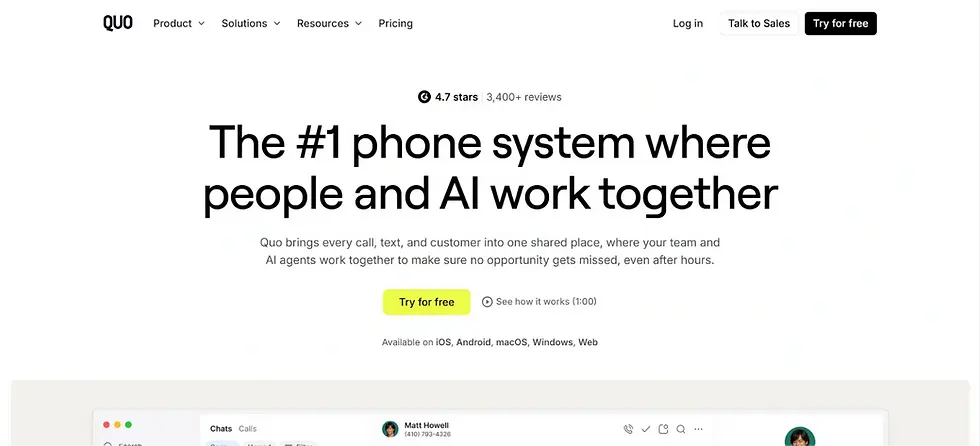
Quo, the company previously known as OpenPhone, is one of the most direct like for like replacements for iPlum for a small growing team. It gives each user a dedicated business number that works across mobile, desktop, and web, with a shared inbox that multiple teammates can use on the same number.
Where Quo pulls ahead of iPlum is team based workflows. It includes AI generated call summaries, shared contact notes, and snippets for common replies, which are the kind of collaboration tools iPlum simply was not built to offer.
Key features:
True desktop and web apps, not just mobile
Shared numbers with round robin call routing
AI call transcripts and summaries
Contact tagging and internal notes visible to the whole team
Plans start around $15 per user per month.
4. Spruce Health

Spruce Health is the alternative built specifically for healthcare, which makes it the closest direct competitor to iPlum's core use case. It combines HIPAA compliant texting, calling, faxing, and even video visits in one platform, aimed squarely at clinics, therapists, and healthcare practices.
The difference from iPlum shows up in depth. Spruce treats compliance as the entire product, with care team workflows, patient scheduling links, and secure document sharing built in, rather than compliance being an upgrade tier bolted onto a general purpose calling app.
Key features:
HIPAA compliant texting, calling, and fax in one platform
Secure video visits for telehealth
Shared care team inbox for clinical staff
Patient scheduling and secure document sharing
Pricing is plan based and generally priced closer to a full healthcare communication platform than a simple calling app, so it is worth comparing total cost against a lighter, texting focused option if a full clinical workflow is not needed.
See Why Regulated Businesses Are Switching to Falkon SMS
Falkon SMS adds compliant, two way texting to the phone number your team already uses, with a shared inbox built for healthcare, legal, and financial teams. No new number, no lost history.
5. Grasshopper

Grasshopper is built for the solo entrepreneur or very small team that wants a professional virtual number without any hardware or complicated setup. It layers business calling, texting, and voicemail on top of an existing personal or mobile phone.
Compared to iPlum, Grasshopper leans further into simplicity. There is no HIPAA specific tier and no shared team inbox, but setup takes minutes and the pricing is flat and easy to understand, which appeals to a freelancer or a one person operation that just wants a business line without managing a second app.
Key features:
Custom greetings, extensions, and a virtual receptionist
Business texting from your existing phone number
Simple flat rate pricing with unlimited use
Fast setup with no hardware required
Plans start at roughly $14 per month for a single number.
6. Dialpad

Dialpad is built for teams that live on the phone all day, particularly sales and support. Its standout feature is real time AI coaching during live calls, along with automatic transcription and sentiment tracking.
Where it differs from iPlum is audience. iPlum is designed for a professional who wants a private second line, while Dialpad is designed for a manager who wants visibility into how an entire team is performing on calls. That makes Dialpad a stronger fit for a call center or sales floor than for a solo practitioner.
Key features:
Live AI call coaching and sentiment analysis
Automatic call transcription and summaries
Unified calling, messaging, and meetings
Integrations with common CRM platforms
Plans start around $15 per user per month.
7. Ooma Office

Ooma Office is aimed at businesses that still want a traditional office phone experience, including physical desk phones, alongside mobile and softphone apps. It is a good fit for a company transitioning away from an old landline system without giving up desk hardware entirely.
The contrast with iPlum is straightforward. iPlum has no desktop app and is not designed around hardware at all, while Ooma is built to support a mixed office of desk phones and mobile users on the same system.
Key features:
Desk phone hardware support alongside mobile apps
Virtual receptionist and call routing
Ring groups and extension dialing
Fax and conferencing options
Plans start around $19.95 per user per month.
8. Sideline

Sideline is one of the simplest options on this list, designed for someone who wants a dedicated second phone number without leaving their existing device or carrier. It is closest to iPlum's original core idea, a personal second line for calls and texts, rather than a full business platform.
The main difference is scope. Sideline stays focused on the individual second line use case, without the team features, compliance tooling, or integrations found in the other tools here, which keeps it lightweight and inexpensive.
Key features:
Dedicated second number for calling and texting
Custom voicemail greetings
Works alongside your existing phone number
Simple month to month plans
Pricing generally sits in the same range as iPlum's base plan.
9. Talkroute

Talkroute is a virtual phone system built for small businesses that want call routing, extensions, and a professional greeting without buying hardware. It sits between the simplicity of Grasshopper and the fuller feature set of RingCentral.
Compared to iPlum, Talkroute puts more emphasis on call flow design, letting a small team set up menus, extensions, and routing rules that direct callers to the right person, which is not something iPlum's single line design supports.
Key features:
Custom call menus and extensions
Call routing to multiple team members
Texting from a business number
Voicemail transcription and call recording on higher tiers
Plans start around $19 per month.
iPlum Alternatives Compared
Alternative | Best For | Starting Price | HIPAA Option | Desktop App |
Falkon SMS | Regulated teams texting from an existing number | Free plan, paid from about $15/user/mo | Yes | Web based |
RingCentral (RingEX) | Full office phone and video system | About $20/user/mo | Yes (higher tiers) | Yes |
Quo (formerly OpenPhone) | Small collaborative teams | About $15/user/mo | No | Yes |
Spruce Health | Healthcare and clinical teams | Plan based | Yes | Web based |
Grasshopper | Solo entrepreneurs | About $14/mo | No | No |
Dialpad | Sales and support teams | About $15/user/mo | Add on | Yes |
Ooma Office | Offices keeping desk phones | About $19.95/user/mo | No | Yes |
Sideline | Individual second line | Similar to iPlum | No | No |
Talkroute | Small teams needing call routing | About $19/mo | No | Web based |
What to Consider When Choosing an iPlum Alternative
Picking the right replacement comes down to matching the tool to how your team actually works, not just picking the cheapest option. Walk through these questions before you decide.
Do you need to keep your existing number, or is a new one fine: Some alternatives, like Falkon SMS, add texting to a number you already use, which avoids reprinting materials or notifying every existing contact. Others issue you a brand new virtual number, which is simpler to set up but means starting fresh.
Does your industry require HIPAA, TCPA, or 10DLC compliance: If you work in healthcare, legal, or financial services, confirm the alternative has compliance built in rather than treated as an afterthought, and check whether carrier registration is handled for you or left as a manual task.
Is this for one person or a whole team: A single user second line has very different requirements than a shared inbox that several employees need to access at once. If more than one person will respond to the same number, look for shared inbox and internal note features specifically.
What does the full price actually include: Compare the base price against what is bundled versus sold as an add on, including toll free numbers, call recording, and API access. A lower sticker price can end up costing more once every feature you actually need is added on.
Which devices does your team use day to day: If your staff work mostly from a computer, a mobile only app will slow them down. If your team is entirely on the road, a desktop first tool adds little value.
How will you get help when something breaks: Check whether support includes live chat or phone access, or if you are limited to email, and read recent reviews for how quickly issues actually get resolved.
Do you need it to connect to other tools you already use: If your team already runs on Microsoft Teams, Slack, HubSpot, or a CRM, prioritize an alternative with a native integration rather than a workaround.
Frequently Asked Questions
What is the best free alternative to iPlum?
Google Voice is the most widely used free alternative for a single user, offering a free personal number with calling, texting, and voicemail transcription. Falkon SMS also offers a free plan for businesses that want to test two way business texting before upgrading.
Is there a HIPAA compliant alternative to iPlum?
Yes. Falkon SMS and Spruce Health both offer HIPAA compliant texting and calling, with Spruce Health built specifically around clinical workflows and Falkon SMS built around team based texting for regulated businesses in healthcare, legal, and financial services.
What app is most similar to iPlum?
Sideline is the closest match to iPlum's original concept of a simple second phone number added to your existing device. For businesses that have outgrown a single second line, Quo (formerly OpenPhone) and Falkon SMS are closer matches once team collaboration and compliance become priorities.
Can I keep my existing phone number with an iPlum alternative?
It depends on the provider. Falkon SMS is built to add texting to a landline, VoIP, or toll free number you already own, so you do not need to switch numbers. Most other alternatives, including iPlum itself, issue you a new virtual number instead.
Why are businesses switching away from iPlum?
The most common reasons are essential features locked behind paid upgrades, occasional texting delivery issues, a dated interface, limited team collaboration tools, and the lack of a true desktop app. None of these make iPlum unusable, but they push growing teams toward more collaborative or more affordable alternatives.
Is Google Voice better than iPlum?
It depends on the use case. Google Voice is cheaper and integrates tightly with Google Workspace, but it lacks the HIPAA specific tooling iPlum offers. For a non regulated solo user already on Google Workspace, Google Voice is often the simpler and cheaper choice.
How much do iPlum alternatives typically cost?
Most alternatives on this list fall between free and about $30 per user per month, depending on the plan tier and whether HIPAA compliance or advanced call features are included. Falkon SMS, Google Voice, and Grasshopper sit at the lower end, while RingCentral and Spruce Health tend to run higher due to their broader feature sets.
What is the best iPlum alternative for a small business team?
For a small team that wants shared texting and compliance support, Falkon SMS and Quo (formerly OpenPhone) are the strongest fits, since both are built around multiple people collaborating on the same number rather than one person's private line.
Final Thoughts
There is no single best iPlum alternative for every business. A solo professional who just wants a private second line is usually well served by Sideline or Google Voice. A healthcare practice with strict compliance needs will get more value from Spruce Health or Falkon SMS. A growing team that wants shared texting, existing number support, and compliance tooling in one place is exactly who Falkon SMS was built for.
The right move is to match the tool to how your team actually communicates today, not just the feature list on a pricing page.
Ready to Text Smarter Than iPlum?
Try Falkon SMS free and see how a shared, compliant business texting inbox works on the number you already have. No credit card required to start.


