Top OnPage Alternatives in 2026 (Compared)


OnPage has built its reputation on one specific promise: critical alerts that are almost impossible to miss. Its Alert-Until-Read technology overrides Do Not Disturb and silent mode, and its escalation rules keep notifying the next person on a schedule until someone actually acknowledges the page. For IT operations teams, managed service providers, and hospital on-call staff, that reliability is the entire point of buying the product.
But no single alerting platform fits every team, budget, or workflow. Some organizations want deeper DevOps tooling and automation, others are migrating away from a sunsetting product like Opsgenie, and healthcare teams often need patient-facing texting alongside internal alerting rather than a pure IT paging tool. That is why "OnPage alternatives" is one of the more common searches among IT leaders, MSPs, and healthcare communication teams evaluating their options for 2026.
This guide walks through why teams look for an OnPage alternative, how we evaluated the field, and a detailed, side-by-side look at ten platforms worth shortlisting, starting with the best options for regulated, patient-facing, and smaller service teams before moving into the larger IT-focused incident management platforms.
What Is OnPage, and What Does It Actually Do?
OnPage is an incident alert management and on-call scheduling platform built around a proprietary Alert-Until-Read system. Rather than sending a single push notification that can be silenced or missed, OnPage alerts ring persistently, override a phone's Do Not Disturb setting, and automatically escalate to the next person on the on-call schedule if the first responder does not acknowledge the alert. The platform is used across IT operations, DevOps, managed service providers, and healthcare organizations that need a live person to see and act on a message quickly, not just receive it.
OnPage's base plan starts at $13.99 per user per month billed annually, or $16.99 per user per month billed quarterly, with Enterprise Silver and Enterprise Gold tiers priced at $22.99 and $28.99 per user per month for organizations that need more advanced routing, integrations, or support.
Why Teams Look for an OnPage Alternative
Most searches for an OnPage alternative come down to one of five recurring reasons.
Cost as the team scales: Per-user alerting pricing adds up quickly once a growing IT team, MSP, or clinical staff roster moves past a handful of seats, especially on the Enterprise tiers.
Overkill for the actual use case: Not every team needs a full escalation-and-on-call engine. Smaller clinics, home care agencies, and service businesses often just need a reliable way to text a patient, client, or team member and know the message was received.
Loud, disruptive notifications: Independent reviews note that OnPage's persistent, attention-demanding alerts, while effective, can feel excessive for lower-urgency use cases. Some reviewers on G2 specifically mention the notification sound as overly loud for their needs.
A broader communication need than pure IT paging: Many organizations searching for OnPage alternatives actually need two-way texting with patients, customers, or field staff in addition to internal alerting, which is outside what OnPage was built to do.
Market disruption in the on-call space: Atlassian's decision to sunset Opsgenie by April 2027 has pushed many teams to re-evaluate their entire alerting stack, including tools adjacent to OnPage, rather than migrate into Jira Service Management by default.
How We Evaluated These OnPage Alternatives
Each platform on this list was scored against six criteria that matter most for critical alerting and on-call communication.
Alert reliability - persistent and escalation-based versus a single push notification
Compliance and security - HIPAA support, Business Associate Agreement availability, and SOC 2 certification
Integration depth - ITSM tools, monitoring platforms, Slack, Microsoft Teams, and EHR systems
Pricing transparency - published per-user pricing versus a custom enterprise quote
Ease of setup - hours or days rather than weeks of implementation
Verified user feedback - real reviews on platforms such as G2 and Capterra
We weighted these differently by use case. IT and DevOps teams should weigh integration depth and escalation logic more heavily. Healthcare, home care, and clinic teams should weigh compliance and ease of setup more heavily. That is why the list below is organized by best fit rather than a single ranking.
OnPage Alternatives at a Glance
The table below compares all ten alternatives by best-fit organization type, standout capability, and starting price, so you can narrow the list before reading the full profiles.
Platform | Best For | Standout Capability | Pricing (Starting) |
Falkon SMS | Clinics, home care, hospice, and mental health teams that need HIPAA compliant alerts plus two-way texting | Reliable SMS-based notifications with secure chat, live in a day | $14.99/user/mo (annual) |
PagerDuty | Enterprise IT and DevOps teams needing full incident lifecycle management | AI-assisted incident response and automation | $21/user/mo |
Opsgenie | Teams already on Jira, migrating ahead of the April 2027 shutdown | Deep Jira Service Management integration (sunsetting) | Custom, being retired |
xMatters | Enterprise teams needing workflow automation across alerting | Flow-based automation connecting monitoring to response | Custom quote |
Splunk On-Call | Teams standardized on the Splunk observability stack | Native Splunk-style routing and dashboards | Custom quote |
Squadcast | DevOps and SRE teams tracking SLOs alongside alerting | Built-in SLO tracking and reliability reporting | Free up to 5 users; from $12/user/mo |
Zenduty | Budget-conscious teams wanting PagerDuty-style features | 100+ integrations with conditional alert routing | Free up to 5 users; from ~$5/user/mo |
ilert | Mid-market teams wanting status pages bundled in | Status pages included with on-call alerting | From ~$14-17/user/mo |
SIGNL4 | Field service and mobile-first alerting teams | Strong push, SMS, and voice fallback alerting | From ~$11/user/mo |
Grafana OnCall | Teams already using Grafana wanting an open-source option | Free, self-hosted or cloud on-call scheduling | Free (self-hosted) |
See How Falkon SMS Compares to OnPage
Get a side-by-side look at HIPAA compliant texting, transparent pricing, and same-day setup before you commit to an alerting platform.
The Top OnPage Alternatives for 2026
Each platform below is scored on the same criteria, but described on its own terms. No two organizations replace OnPage for the same reason, so the right pick depends on whether the core need is IT incident escalation, DevOps reliability tracking, or compliant patient and team communication.
1. Falkon SMS
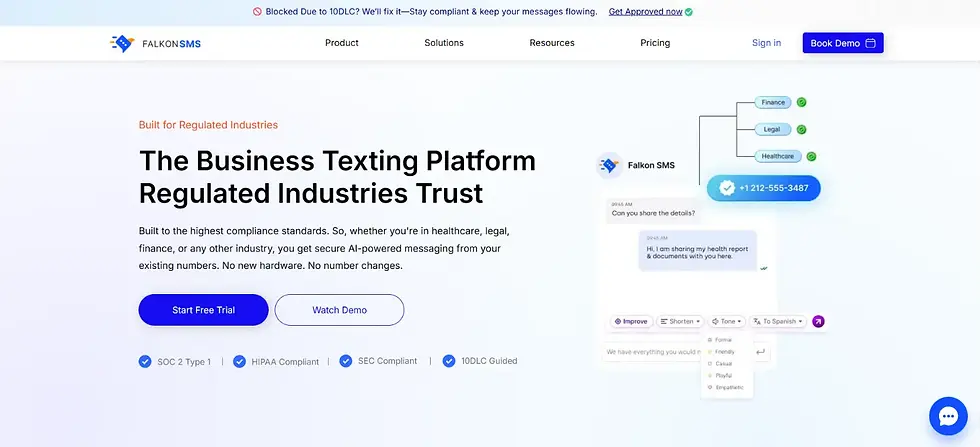
Falkon SMS approaches the OnPage alternative question from a different angle than most incident management vendors. Rather than positioning itself as a full escalation and on-call scheduling engine, it is built around HIPAA compliant business texting that reaches patients, clients, and team members on the phone number they already use, alongside secure two-way chat, group broadcast, and scheduled messaging for internal teams.
Falkon SMS is HIPAA compliant with a signed Business Associate Agreement available on paid plans and is SOC 2 certified, giving smaller healthcare organizations, home care agencies, hospice teams, and mental health centers verified evidence of its security controls.
Its shared inbox, message templates, keyword auto-replies, and delivery reporting make it a practical way to send an important message and confirm it landed, without the overhead of a dedicated on-call engine.
Where it wins over OnPage: published per-user pricing starting at $14.99 per user per month on an annual plan, same-day setup, and two-way texting that goes beyond internal IT paging to include patient and customer communication. It is a practical fit for clinics, specialty practices, home care and hospice agencies, and mental health centers that want dependable, compliant messaging without hospital-scale infrastructure or a dedicated on-call engineering budget.
Where it is not the right fit: Falkon SMS does not replicate OnPage's Alert-Until-Read escalation logic, on-call scheduling rotations, or deep ITSM integrations with tools like Jira, ServiceNow, or ConnectWise. Organizations that need alerts to override Do Not Disturb automatically and escalate through a formal on-call chain for mission-critical IT infrastructure should look at OnPage itself, PagerDuty, or one of the dedicated incident alerting tools covered next.
2. PagerDuty

PagerDuty is one of the most established names in incident management, combining alerting with AI-assisted operations features, automated workflows, and detailed post-incident analytics. It is frequently the default choice for large enterprise IT and DevOps organizations that need a complete incident lifecycle platform rather than a lighter alerting layer.
Where it wins over OnPage: broader automation and orchestration capabilities, deeper analytics on incident trends and response times, and a large ecosystem of integrations built for complex enterprise environments.
Where it falls short: pricing starts at $21 per user per month for the Professional plan and rises to $41 per user per month for the Business plan before add-ons, which makes it expensive for smaller teams that only need reliable alerting and escalation rather than a full incident management suite.
3. Opsgenie
Opsgenie has long been one of the most widely used incident alerting tools, especially for teams already standardized on Atlassian's Jira Service Management. However, Atlassian ended new sales of standalone Opsgenie in June 2025 and plans a full shutdown by April 2027, which means every current Opsgenie customer needs a migration plan in the near term.
Where it wins over OnPage: tight native integration with Jira Service Management for teams staying inside the Atlassian ecosystem during the transition period.
Where it falls short: the announced shutdown means Opsgenie is not a viable long-term choice for new deployments. Current Opsgenie customers are actively evaluating OnPage, PagerDuty, and other platforms on this list as replacements.
4. xMatters

xMatters focuses on workflow automation that connects monitoring tools, ITSM platforms, and communication channels into a single orchestrated response process, rather than functioning purely as an alerting tool.
Where it wins over OnPage: flow-based automation that can trigger multi-step responses, not just notifications, across a wide range of connected systems.
Where it falls short: pricing requires a custom quote rather than published tiers, and the platform's flexibility can mean a longer setup and configuration process for teams that just need dependable, persistent alerting without building out complex workflows.
5. Splunk On-Call (formerly VictorOps)
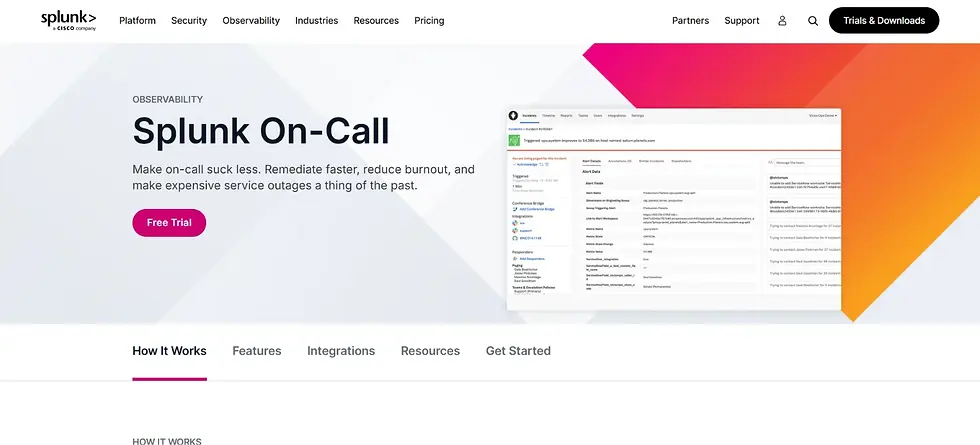
Splunk On-Call is a natural fit for teams already invested in the Splunk observability and monitoring ecosystem, since it shares data and routing logic natively with Splunk's broader platform.
Where it wins over OnPage: seamless integration with existing Splunk dashboards and alerts for teams that already rely on Splunk for monitoring.
Where it falls short: teams that are not already using Splunk gain little from this integration advantage, and pricing again requires a direct conversation with sales rather than a published rate card.
6. Squadcast (SolarWinds IT Incident Response)

Squadcast was built specifically for DevOps and site reliability engineering teams that want incident alerting paired with service-level objective tracking and reliability reporting in the same platform.
Where it wins over OnPage: built-in SLO tracking that connects incident response directly to reliability targets, plus a free tier for up to five users that makes it accessible for small teams to test.
Where it falls short: its SRE-focused feature set is less relevant for healthcare or general business alerting use cases, where OnPage's or Falkon SMS's simpler models are usually a better match.
7. Zenduty

Zenduty positions itself as a more affordable, feature-comparable alternative to PagerDuty and OnPage, with conditional alert routing designed to reduce noise from low-priority notifications.
Where it wins over OnPage: over 100 integrations spanning application performance monitoring, log monitoring, error tracking, and ITSM tools, plus a free tier for teams of five or fewer and paid plans starting around $5 per user per month.
Where it falls short: as a younger platform, its market presence and enterprise support infrastructure are less established than OnPage's or PagerDuty's, which matters for organizations that prioritize long-term vendor stability.
8. ilert
ilert is a mid-market on-call and alerting provider known for bundling status pages directly into its base plans, avoiding the common practice of charging separately for a status page tool.
Where it wins over OnPage: status pages included at no extra cost, plus solid escalation policy configuration for mid-sized IT teams.
Where it falls short: its integration catalog and enterprise feature depth are narrower than OnPage's, which offers more than 250 integrations and can matter for larger, more complex IT environments.
9. SIGNL4

SIGNL4 is a mobile-first alerting tool that emphasizes push notifications, SMS, and voice call fallback for field service teams and distributed workforces, not just office-based IT staff.
Where it wins over OnPage: strong fallback logic across multiple channels for teams whose staff may not always have reliable app connectivity, such as field technicians.
Where it falls short: it is more narrowly focused on mobile alerting than OnPage's broader incident management feature set, including detailed escalation policies and a centralized contact directory.
10. Grafana OnCall

Grafana OnCall is an open-source on-call management tool that integrates natively with the Grafana observability stack, giving teams a self-hosted or Grafana Cloud-hosted alternative with no per-user licensing cost.
Where it wins over OnPage: no licensing fee for the open-source, self-hosted version, and native integration for teams already using Grafana dashboards.
Where it falls short: self-hosting requires the team to manage its own infrastructure, database, and telephony gateway for SMS and voice alerts, which shifts cost from a subscription to engineering time and third-party services such as Twilio.
What to Consider When Choosing an OnPage Alternative
Match the tool to the actual failure mode you are solving: A dedicated escalation and on-call engine like OnPage or PagerDuty exists to guarantee a live person acknowledges a critical alert. If the real need is dependable two-way texting with patients or clients, a texting-first platform like Falkon SMS is a better match than an over-built IT alerting tool.
Confirm compliance requirements up front: Healthcare organizations need a signed Business Associate Agreement and, ideally, independent security certification such as SOC 2, not just a vendor's word that the platform is HIPAA-friendly.
Get pricing in writing before comparing options: Several platforms on this list, including xMatters and Splunk On-Call, require a custom quote. Ask for itemized, per-user pricing and any add-on fees before making a side-by-side comparison.
Check integration depth against the actual stack: If the team already runs Jira, ServiceNow, Slack, or Microsoft Teams, confirm native integrations exist rather than assuming an open API will cover the gap without extra engineering time.
Read verified reviews, not just vendor pages: Independent platforms like G2 and Capterra surface real feedback on alert reliability, support responsiveness, and day-to-day usability, including specific complaints such as an overly loud default notification sound.
Plan for a phased migration, not a single cutover: This matters most for anyone migrating off Opsgenie ahead of its 2027 shutdown or switching a live on-call rotation to a new platform.
Switching From OnPage Without Disrupting Coverage
A safe migration away from OnPage, or any incident alerting platform, typically runs in four stages.
Run a parallel pilot first: Keep the current platform active for a subset of the team while the new one runs alongside it for two to four weeks, so gaps surface before a full cutover.
Migrate one team or department at a time: Rolling migrations limit the risk that an edge case in escalation policy or routing gets missed during a live incident.
Export historical alert and message logs: Compliance and audit requirements often outlast the vendor relationship, so confirm export and retention options before decommissioning the old platform.
Set the cutover date based on staff confirmation: The safest signal that a migration is ready is direct confirmation from on-call staff that alerts are reliably reaching them on the new platform, not a project deadline on a calendar.
Ready for Simpler, HIPAA Compliant Alerting?
Start a free trial of Falkon SMS and see how secure two-way texting and reliable notifications can go live for your team in a single day.
Frequently Asked Questions
What is the best OnPage alternative in 2026?
There is no single best OnPage alternative for every organization. Falkon SMS is generally the strongest fit for clinics, home care agencies, hospice teams, and mental health centers that want HIPAA compliant, two-way texting without the cost or complexity of a dedicated on-call escalation engine. PagerDuty and xMatters are stronger fits for large enterprise IT and DevOps teams that need full incident lifecycle management, while Squadcast, Zenduty, and Grafana OnCall are solid budget-friendly options for smaller technical teams.
Is there a free OnPage alternative?
Yes. Grafana OnCall is free and open source for self-hosted deployments, and both Squadcast and Zenduty offer free tiers for teams of five users or fewer. Falkon SMS also offers a free trial with no credit card required before moving to a paid plan starting at $14.99 per user per month.
What is happening to Opsgenie, and does that affect OnPage alternatives?
Atlassian ended new sales of standalone Opsgenie in June 2025 and has announced a full product shutdown by April 2027. This has pushed many Opsgenie customers to evaluate OnPage, PagerDuty, xMatters, and other platforms on this list as replacements rather than migrating into Jira Service Management by default.
Is Falkon SMS a good replacement for OnPage?
Falkon SMS is a strong replacement for organizations whose main need is reliable, HIPAA compliant patient or client texting alongside secure internal team chat, such as clinics, home care agencies, hospice providers, and mental health centers. It is not designed to replace OnPage's Alert-Until-Read escalation logic or formal on-call scheduling for mission-critical IT infrastructure, so IT operations and DevOps teams with those specific needs should consider OnPage itself, PagerDuty, or Squadcast instead.
How much does OnPage cost compared to its alternatives?
OnPage's base plan starts at $13.99 per user per month billed annually, with Enterprise tiers at $22.99 and $28.99 per user per month. PagerDuty starts at $21 per user per month. Falkon SMS starts at $14.99 per user per month on an annual plan. Squadcast and Zenduty both offer free tiers for small teams, with paid plans starting around $5 to $12 per user per month.
Are OnPage alternatives HIPAA compliant?
Not all of them. Falkon SMS and OnPage both support HIPAA compliant communication and offer a Business Associate Agreement. General-purpose IT incident management tools like PagerDuty, xMatters, and Splunk On-Call are built primarily for IT and DevOps use cases and should be evaluated directly with the vendor if protected health information will pass through the platform.
How long does it take to switch from OnPage to another platform?
Timelines vary by platform and organization size. Cloud-based texting platforms like Falkon SMS can often be set up in a single day. Enterprise incident management platforms with complex escalation policies, integrations, and on-call schedules can take anywhere from a few days to several weeks to fully migrate, and a phased, team-by-team rollout is recommended to avoid disrupting live coverage.
Do OnPage alternatives support two-way texting with patients or customers, not just internal alerts?
Most dedicated incident alerting platforms, including OnPage, PagerDuty, xMatters, and Squadcast, are built for internal IT and on-call communication rather than patient or customer-facing texting. Falkon SMS is built specifically for two-way texting with patients, clients, and team members in addition to internal notifications, which makes it a better fit for organizations that need both.
Final Takeaway
OnPage remains a solid choice for teams that need guaranteed, escalation-based incident alerting. But "best OnPage alternative" depends entirely on what the alert is actually for. IT operations and DevOps teams weighing automation and integration depth should look closely at PagerDuty, xMatters, Squadcast, or Grafana OnCall. Organizations whose core need is reliable, compliant communication with patients, clients, or a smaller care team, without the cost or complexity of a full on-call engine, will generally find Falkon SMS the more practical starting point.