The Risks of Insecure Text Messaging in Healthcare
- Amila Udowita

- 2 days ago
- 9 min read
Texting has become the default way people communicate, and healthcare is no exception. Patients ask questions over text. Physicians coordinate with on-call colleagues through their personal phones. Care teams share updates about medications, appointments, and lab results in a thread that looks just like any other conversation on their device. It feels fast, familiar, and efficient.
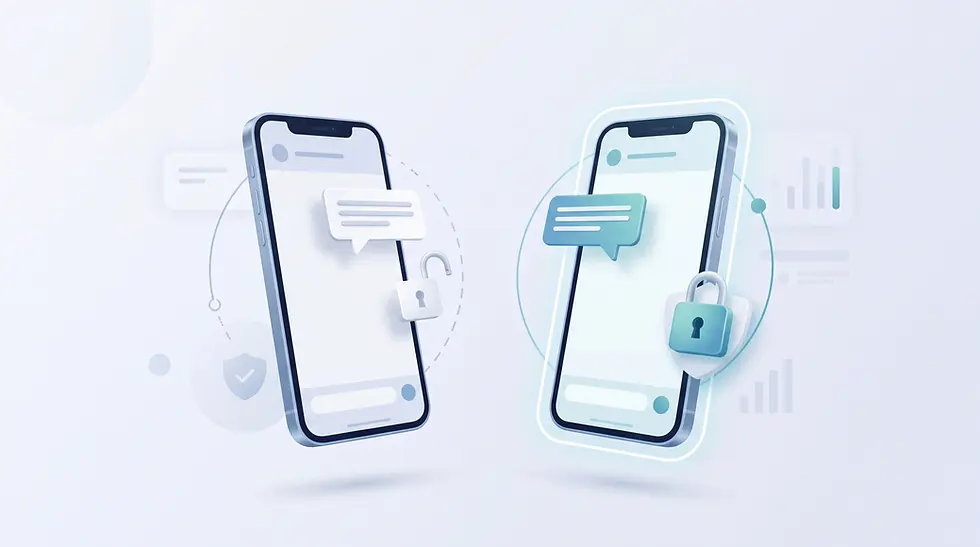
The problem is that the text messaging most people use every day, standard SMS and default messaging apps, was never built to carry sensitive medical information. It lacks encryption, access controls, and the audit trail that healthcare regulations require. When protected health information moves through these unsecured channels, it creates real risk for patients, providers, and the organizations that employ them.
This guide breaks down what makes standard text messaging insecure, the specific risks healthcare organizations face when they rely on it, and what a safer approach to healthcare text messaging looks like.
Why Healthcare Organizations Keep Turning to Text Messaging
Despite the risks, text messaging keeps growing across healthcare. It is fast, it fits into already busy workflows, and patients respond to it. Nearly all American adults now own a cellphone, and most people glance at a text message within minutes of receiving it. For a care team trying to confirm an appointment, remind a patient about medication, or coordinate a shift change, that kind of responsiveness is hard to match with phone calls or a patient portal login.
The trouble is that convenience and compliance are not automatically the same thing. A message that is easy to send is not necessarily a message that is safe to send, and the gap between those two ideas is where most healthcare texting risk begins.
What Makes Standard Text Messaging Insecure
To understand the risk, it helps to know exactly where ordinary SMS and default messaging apps fall short of what healthcare communication requires.
No encryption in transit or at rest
Standard SMS messages travel across carrier networks in a format that is not end to end encrypted, which means it can potentially be intercepted at various points along that path. Messages are also often stored in plain text on the device itself, and sometimes on carrier servers, rather than encrypted so only the sender and recipient can read them.
No reliable access controls
Most personal messaging apps do not require a separate login, session timeout, or verification step beyond unlocking the phone. If a phone is unlocked, whoever is holding it can typically read every message thread on it, including anything containing patient details.
No audit trail
Healthcare compliance depends on being able to show who accessed protected health information, when, and why. Standard texting apps were not designed with that requirement in mind. There is usually no centralized log of who sent what, no way to retrieve a message after a device is lost, and no way to prove what was or was not shared if a dispute comes up later.
Messages live on personal devices
When staff text from personal phones, PHI ends up mixed in with a phone's ordinary text history, its cloud backups, and any app that has access to its message data. That data can persist long after a conversation ends and long after an employee has left the organization. This is one reason many practices move toward HIPAA compliant texting instead of relying on personal numbers.
The Real Risks of Insecure Text Messaging in Healthcare
HIPAA violations and financial penalties
Under HIPAA, unsecured protected health information sent by SMS to unauthorized parties, or without appropriate safeguards, can count as a reportable disclosure. Penalties are tiered based on the level of negligence involved, and current penalty caps can reach well over two million dollars per violation category per year. Beyond the fine itself, an organization found in violation typically faces a corrective action plan and ongoing monitoring. A closer look at HIPAA texting dos and don'ts shows how easily well-intentioned habits can cross into violation territory.
Data breaches and exposed patient records
Healthcare has consistently been one of the most expensive industries for data breaches. Recent industry reporting puts the average cost of a healthcare data breach well above nine million dollars per incident, driven up by breach notification, legal response, patient credit monitoring, and lost business. A text thread containing names, diagnoses, appointment details, or account numbers becomes one more channel that a breach investigation has to account for.
Phishing and smishing attacks aimed at healthcare staff
Attackers increasingly target healthcare employees directly, since clinical and administrative staff often have access to valuable patient data and work under time pressure that makes it easier to trick them. Industry research shows healthcare is now one of the most heavily targeted sectors for phishing, and SMS based phishing, known as smishing, has grown as a specific tactic because people tend to trust text messages more than email. A staff member used to receiving routine texts from a scheduling tool is an easier target for a message that looks similar but is not. Understanding how to protect text messages from this kind of impersonation is now a basic part of healthcare security training.
Lost or stolen devices
A phone left in a car, a tablet forgotten in a break room, or a personal device lost while traveling can expose every unencrypted message thread stored on it. Without remote wipe capability, encryption, or a way to revoke access, a lost device can turn into an unplanned disclosure of patient information.
Employee turnover and unmanaged access
When staff text patients from personal numbers, those conversation threads do not automatically transfer with the employee's role. If someone leaves the organization, their personal phone may still hold months of patient conversations, and the organization has no practical way to retrieve or delete that data.
Erosion of patient trust
Beyond the regulatory and financial risk, there is a relationship cost. Patients share sensitive details, symptoms, mental health concerns, financial information, because they trust a provider to protect it. A breach involving something as ordinary as a text message can damage that trust in a way that is hard to repair, even for a well regarded practice.
See How Secure Texting Protects Your Patients
Falkon SMS gives healthcare teams encrypted, HIPAA compliant texting with a signed BAA, role based access, and a full audit trail, so patient conversations stay protected instead of sitting unsecured on personal phones.
What a Breach Actually Looks Like in Practice
A typical scenario starts small. A staff member texts a lab result to the wrong number, or a phone is stolen with months of patient message threads on it. Once protected health information is exposed, the organization has to determine the scope of the breach, notify affected patients within a set window, and in larger cases, notify the Department of Health and Human Services and the media. Investigation and notification alone typically cost well over a hundred dollars per affected record, before legal fees, monitoring services, or long term reputational damage are even factored in.
Smaller practices sometimes assume they are not a target, but breach investigations consistently show that everyone from solo practices to large hospital systems is at risk, in part because attackers automate their outreach rather than picking targets one at a time.
Insecure Texting Risks Beyond HIPAA
HIPAA is not the only framework at stake. Practices that treat substance use disorders are also bound by 42 CFR Part 2, which places even stricter limits on how treatment related information can be shared, including by text. Many states also have their own data breach notification laws with tighter timelines or broader definitions of personal information than federal law requires. An insecure texting habit that seems like a minor HIPAA gap can turn into a multi-layered compliance problem once state law and specialty specific rules are added to the picture.
Common Insecure Texting Habits Worth a Second Look
Some of the riskiest texting habits look completely ordinary from the inside.
Sending appointment reminders that include a patient's full name and reason for visit
Texting lab results or medication changes directly to a patient's personal number
Coordinating shift handoffs over group texts that include patient identifiers
Allowing staff to text patients from personal cellphones instead of a business number
Storing patient phone numbers in a personal contacts list rather than a managed system
Never confirming that a phone number still belongs to the intended patient before sending sensitive information
None of these habits look reckless in the moment. They usually start as a well-intentioned shortcut that becomes routine, and that is exactly how insecure texting becomes normalized inside an organization.
How to Reduce the Risk of Insecure Text Messaging
Move to a HIPAA compliant texting platform
A secure HIPAA texting platform encrypts messages in transit and at rest, requires authenticated access, and keeps a complete audit trail of every message sent and received. Platforms built specifically for healthcare, like Falkon SMS, are designed around these requirements from the ground up rather than adding them on top of a consumer messaging app.
Get a signed Business Associate Agreement
Any texting vendor that handles PHI on behalf of a covered entity needs to sign a BAA. This is a basic requirement, not an optional add-on, and a vendor unwilling to sign one is a clear warning sign. If you are unsure whether your organization needs one, this guide on whether you need a BAA to text patients walks through the specifics.
Train staff to recognize phishing and smishing
Technical safeguards only go so far if staff cannot recognize a suspicious text asking them to click a link or share credentials. Regular, practical training on what a smishing attempt looks like reduces the chance that one distracted click turns into a full breach.
Set clear device and access policies
Whether staff use company issued phones or a bring your own device policy, organizations need clear rules about screen locks, remote wipe capability, and which applications are approved for patient communication.
Keep a complete audit trail
Being able to show exactly who accessed a message, when, and from where is one of the fastest ways to demonstrate compliance during an audit or investigation, and one of the hardest things to reconstruct after the fact if it was never captured in the first place.
What to Look for in a Secure Healthcare Texting Platform
Not every messaging tool marketed to healthcare organizations meets the same bar. When evaluating a platform, look for:

End to end encryption for messages and attachments
A signed Business Associate Agreement
Role based access controls and authentication
A complete, exportable audit trail
Secure file sharing for images, documents, and lab results
The ability to text enable an existing business number instead of relying on personal phones
SOC 2 or equivalent independent security certification
Falkon SMS covers each of these areas for healthcare teams that want to keep texting without carrying the compliance risk of standard SMS, including secure file sharing for documents and images that would otherwise travel unprotected.
Frequently Asked Questions
Is text messaging HIPAA compliant?
Standard SMS is not HIPAA compliant because it lacks encryption, access controls, and an audit trail. Texting can be part of a HIPAA compliant workflow only when it runs through a platform built for that purpose, backed by a signed BAA and appropriate safeguards.
What happens if a healthcare provider sends PHI over unencrypted text?
It can count as an impermissible disclosure of protected health information under HIPAA. Depending on the scope and cause, this can lead to a required breach notification, an OCR investigation, and financial penalties.
Can text messages be intercepted?
Yes. Standard SMS travels across carrier networks without end to end encryption, which means it can potentially be intercepted at points along that path, unlike messages sent through a properly encrypted secure platform.
What is smishing?
Smishing is phishing conducted through text message rather than email. Attackers send a text designed to look like it comes from a trusted source, such as a pharmacy or scheduling system, to trick the recipient into clicking a malicious link or sharing sensitive information.
Do healthcare texting platforms need a Business Associate Agreement?
Yes. Any vendor that transmits or stores protected health information on behalf of a covered entity needs to sign a BAA. A platform that will not sign one should not be used for anything involving PHI.
What is the penalty for a HIPAA violation involving text messaging?
Penalties are tiered based on the level of negligence and can reach well over a million dollars per violation category per year at the highest tier, in addition to costs like breach notification, legal fees, and corrective action plans.
How can healthcare organizations text patients without violating HIPAA?
By using a secure texting platform with encryption, access controls, and an audit trail, backed by a signed BAA, and by training staff on safe texting habits and how to spot phishing attempts.
Bringing It Together
Text messaging is not going away as a healthcare communication channel, and it should not have to. Patients want it, and it genuinely improves things like appointment attendance and response times. What has to change is the assumption that the same texting app used for personal conversations is safe enough for protected health information. The gap between those two things is where the real risk sits, and closing it comes down to using a platform designed for healthcare, backing it with a signed BAA, and training the people who use it every day.
Ready to Replace Risky Texting With a Compliant Alternative?
Talk to the Falkon SMS team about moving your patient communications to a secure, HIPAA compliant texting platform built for healthcare teams.