Top Hucu.ai Alternatives in 2026 for Healthcare Teams


Hucu.ai has built a loyal following among skilled nursing facilities, hospice organizations, and home health agencies that need one place to coordinate a patient's care across multiple outside partners. Patient-specific channels, acuity scoring, and a free-forever Basic tier have made it an easy first step for post-acute teams tired of juggling faxes, phone tag, and unencrypted texts.
But Hucu.ai is not the only option, and it is not the right fit for every organization. Some teams find the free tier too limited once they need more than 10 users or 14 days of message history. Others need a texting platform that also covers billing and financial communication under SEC or FINRA rules, which sits outside Hucu.ai's healthcare-only scope. Larger hospital systems often need EHR-embedded alarm routing and on-call scheduling that goes well beyond what a post-acute coordination tool was built to do.
This guide walks through why organizations look for a Hucu.ai alternative, how we evaluated the platforms on this list, and a closer look at the eight tools healthcare teams are actually switching to in 2026.
Why Healthcare Teams Look for a Hucu.ai Alternative in 2026
Organizations most commonly move away from Hucu.ai for five reasons: paid pricing that requires a sales conversation, a platform scoped narrowly to post-acute care, per-patient or per-location costs that scale unpredictably, a free tier that becomes restrictive as a team grows, and no built-in support for non-healthcare compliance needs such as SEC or FINRA archiving.
Pricing That Requires a Sales Conversation
Hucu.ai's free Basic plan is genuinely free, but the moment an organization needs native SMS routing, EHR sync, escalation logic, or unlimited message history, it has to move to the Plus, Pro, or Enterprise tier. None of those tiers publish exact pricing, so budgeting means contacting sales and waiting on a custom quote before comparing costs against other vendors.
A Platform Built Narrowly for Post-Acute Care
Hucu.ai is purpose-built for skilled nursing facilities, hospice, home health, home care, physician and nurse practitioner groups, Area Agencies on Aging, ACOs, and Medicare Advantage plans. That focus is a strength for its core audience, but a mental health clinic, a specialty practice, or a home care agency that also needs to text patients about billing, insurance, or general appointment logistics may find the tool more specialized than they need.
Per-Patient or Per-Location Pricing That Scales Unpredictably
Rather than per-user pricing, Hucu.ai charges per patient or per location. For organizations with fluctuating census counts or seasonal patient volume, that model can make monthly costs harder to forecast compared with a flat per-seat rate.
Limits on the Free Basic Tier
The free-forever Basic plan is capped at 10 patient channels, 10 discussion channels, 10 users, and 14 days of message history. That is enough for a small pilot, but organizations that need longer retention for compliance documentation or more than 10 active users quickly run into the ceiling.
No Built-In Support for Non-Healthcare Compliance Needs
Hucu.ai's compliance story is entirely healthcare focused. Organizations that also need SEC Rule 17a-4 or FINRA-compliant message archiving, such as a health system's revenue cycle team, a home care agency's billing department, or a law firm handling medical settlements, need a platform built for both worlds rather than adding a second tool.
How We Evaluated These Hucu.ai Alternatives
Every platform on this list was scored against seven criteria that matter specifically for regulated healthcare communication.
HIPAA compliance and BAA availability: Does the vendor sign a Business Associate Agreement, and is compliance built into the core product?
Independent security certification: Has the platform completed a third-party audit such as SOC 2, and does it publish the results?
Core communication features: Does it offer encrypted messaging, secure file sharing, audit trails, and role-based access, beyond basic texting?
Reliability and real-world performance: What do verified users report about uptime, message delivery, and support responsiveness?
Integration depth: Can it connect to EHRs, scheduling systems, or everyday tools like Microsoft Teams and Slack?
Pricing transparency: Is pricing published, or does it require a sales call before an organization can even estimate cost?
Verified user feedback: What do independent review platforms such as G2 and Capterra say, apart from vendor marketing?
These criteria carry different weight depending on organization size. A large hospital system should weight EHR integration and alarm management more heavily. A clinic, specialty practice, or home care agency should weight pricing transparency and setup speed more heavily. That is why this list is organized by who each platform actually fits best, rather than a single ranking that treats every organization the same.
Hucu.ai Alternatives at a Glance
The table below compares the eight platforms covered in this guide by best-fit organization type, standout capability, and pricing model, so you can narrow the list before reading the full profiles.
Platform | Best For | Standout Capability | Pricing Model |
Falkon SMS | Clinics, specialty practices, home care, hospice, and mental health providers that need compliant texting across both clinical and billing conversations | HIPAA and SEC ready texting plus an AI engine trained on your own SOPs, live in a day | Starting from $14.99/user/month (annual) |
HosTalky | Post-acute teams that want an all-in-one collaboration app | CareID identity system plus built-in task management and broadcast messaging | Custom quote |
TigerConnect | Large hospital systems and health networks | All-in-one clinical collaboration with voice, video, and alarm management | Custom quote |
PerfectServe | Multi-specialty groups with heavy on-call scheduling needs | Automated on-call scheduling tied directly to secure messaging | Custom quote |
Spok Care Connect | Large hospitals needing alarm routing and EHR-embedded alerts | Enterprise-grade alarm management and paging infrastructure | Custom quote |
OhMD | Ambulatory practices wanting to cut inbound call volume | AI voice assistant that deflects routine calls into secure text | Starting around $300/month |
QliqSOFT | Home health, hospice, and skilled nursing teams wanting messaging plus patient chatbots | Cloud Pass-Thru architecture keeps PHI off Qliq's own servers | Custom quote |
DrFirst Backline | Care teams coordinating prescriptions and telehealth visits | Secure messaging tied directly to medication and prescribing workflows | Custom quote |
The Top Hucu.ai Alternatives for Healthcare Teams in 2026
Each platform below is scored on the same criteria but described on its own terms. No two organizations replace Hucu.ai for the same reason, so no two profiles here read the same way.
1. Falkon SMS

Falkon SMS approaches the Hucu.ai alternative question from a different angle than most post-acute care tools. Instead of building patient-specific coordination channels first, it starts with HIPAA compliant text messaging that reaches patients and families on the phone number they already use, alongside secure internal chat for care teams, and applies that same compliance foundation to billing, legal, and financial conversations as well.
Falkon SMS is HIPAA and SEC compliant, with a signed Business Associate Agreement available on the Pro plan, and it is SOC 2 Type I certified, giving organizations independently verified evidence of its security controls. Day to day, it provides Secure Chat for confidential sessions, secure file sharing through expiring links, role-based access with three permission tiers, a shared team inbox with assignable conversations, and the Falkon AI Engine, which can be trained on internal SOPs to draft compliance-safe reply suggestions.
Two-way SMS and MMS with group broadcasts to up to 2,000 contacts per send
Scheduled and recurring messages with bulk Excel import for appointment reminders and outreach
Keyword auto-replies and custom contact fields for personalized, templated messaging
Managed 10DLC registration, handled by the Falkon team as part of onboarding
Integrations with everyday business tools, including Microsoft Teams, Slack, HubSpot, Clio, and Webex
Where it wins over Hucu.ai: published per-user pricing starting at $14.99 per user per month instead of a per-patient quote, same-day setup, compliance coverage that extends to SEC and FINRA archiving for organizations that also handle billing or financial communication, and integrations into tools sales, support, and legal teams already use. It fits healthcare providers, home care agencies, hospice teams, mental health centers, and IDD providers that want secure, compliant texting without a per-patient pricing model.
Where it is not the right fit: Falkon SMS does not currently offer native EHR integration with systems like PointClickCare or ChartPath, and it does not include Hucu.ai's patient acuity scoring or automated escalation logic. Organizations that specifically need those cross-organization, patient-record-tied workflows, or that want to start on a free-forever plan before committing budget, may still find Hucu.ai's core product a better starting point. A full side-by-side is available in the Falkon SMS vs Hucu.ai comparison.
2. HosTalky

HosTalky positions itself as an all-in-one communication tool for healthcare teams, built around a personalized CareID that each user creates at sign-up to serve as their identifier across the platform. It bundles secure, HIPAA-compliant messaging with task management and broadcast messaging for organization-wide announcements, aiming to replace several disconnected apps with one workspace.
Where it wins over Hucu.ai: built-in task assignment and tracking alongside messaging gives teams accountability tools that Hucu.ai does not emphasize as heavily, and its broadcast messaging is designed for fast, organization-wide updates.
Where it falls short: HosTalky is a newer entrant compared with the established post-acute integrations Hucu.ai offers, and it does not publish the same depth of independent third-party review coverage as more established platforms on this list.
3. TigerConnect

TigerConnect is one of the most established names in clinical collaboration, combining secure texting, voice calling, and video into a single platform used across many hospital networks. It has invested heavily in alarm management and nurse call integration, which puts it in direct competition with enterprise platforms like Spok at the hospital scale end of the market.
Where it wins over Hucu.ai: far deeper EHR and nurse call integration, native voice and video calling built into clinical workflows, and a feature set designed for hospital-wide alarm routing rather than post-acute, cross-organization coordination alone.
Where it falls short: that same breadth can be more than a skilled nursing facility, hospice, or home care agency actually needs, and like most enterprise platforms, pricing is custom-quoted rather than published.
4. PerfectServe
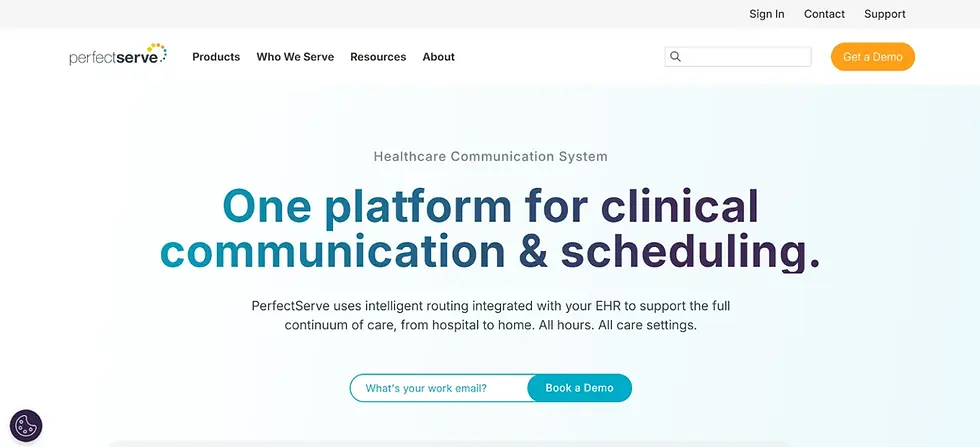
PerfectServe grew out of answering-service replacement and physician scheduling, and that heritage still shows in how tightly its scheduling engine is tied to its secure messaging layer. The company has won multiple Best in KLAS awards for clinical communication and reports serving 500 plus hospitals and 30,000 plus medical practices across the US.
Where it wins over Hucu.ai: automated on-call scheduling logic built as a first-class feature, plus proven results at scale, including customer-reported reductions in call-back time and clinician response delays.
Where it falls short: PerfectServe is built for scheduling-driven communication across a hospital or multi-specialty group, which is a different problem than Hucu.ai's patient-specific, cross-organization coordination model, and pricing again requires a custom quote.
5. Spok Care Connect

Spok Care Connect has long been one of the most recognized names in clinical communication, built at a time when hospitals needed a reliable way to get an urgent message to the right person fast. It remains a strong fit for hospital-scale alarm routing, on-call scheduling, and EHR integration for large health systems.
Where it wins over Hucu.ai: mature, enterprise-grade alarm and paging infrastructure for large hospitals, which sits outside the scope of a post-acute coordination tool.
Where it falls short: Spok's roots in paging mean many deployments still lean on provisioned hardware, pricing is not published, and implementation commonly takes weeks to months, which is a heavier lift than a ten-provider clinic or home care agency typically needs.
6. OhMD

OhMD focuses on ambulatory practices drowning in inbound phone calls. Its AI voice assistant, Nia, answers routine calls and deflects standard inquiries into secure text conversations, and the platform integrates with more than 85 EHR systems including Epic, athenahealth, and eClinicalWorks. OhMD reports being used by over 40,000 providers and more than 1,200 practices.
Where it wins over Hucu.ai: purpose-built AI call deflection for high call volume outpatient practices, plus broad, published EHR integration coverage and clearer entry-level pricing starting around $300 per month.
Where it falls short: OhMD is built for single-practice, patient-to-provider communication rather than the cross-organization, multi-partner coordination that post-acute and hospice teams rely on Hucu.ai for.
7. QliqSOFT

QliqSOFT is a HIPAA-compliant secure messaging platform with a similar post-acute focus to Hucu.ai, serving home health, hospice, and skilled nursing organizations. Its Cloud Pass-Thru architecture keeps messages and PHI stored behind the organization's own firewall rather than on QliqSOFT's servers, and its Quincy chatbot product extends the platform into patient-facing intake, screening, and education.
Where it wins over Hucu.ai: a distinctive data sovereignty model for organizations that want PHI to never touch a third-party cloud, plus on-call scheduling and an AI chatbot for patient intake bundled into the same platform.
Where it falls short: some reviewers note the platform can feel dated compared with newer entrants, and pricing requires a custom quote rather than being published up front.
8. DrFirst Backline

DrFirst built its name in e-prescribing and medication management, and Backline extends that focus into secure clinical messaging and telehealth-enabled communication. It is a natural fit for care teams where medication coordination, pharmacy communication, and telehealth visits are central to daily workflow.
Where it wins over Hucu.ai: deeper native alignment with prescribing and medication management data than a general care coordination platform can offer, along with telehealth-ready secure messaging.
Where it falls short: outside of prescription and medication-centric workflows, Backline is a narrower fit than a platform built primarily for general post-acute care coordination, and pricing requires direct contact with DrFirst.
What to Consider When Choosing a Hucu.ai Alternative
Before committing to any platform on this list, healthcare organizations should confirm HIPAA compliance and BAA availability, check for independent security certification, map features against actual daily workflows, confirm EHR or scheduling integration, understand the real implementation timeline, get pricing in writing, and read verified reviews rather than relying on vendor demos alone.
Compliance and security first: Confirm the vendor will sign a Business Associate Agreement and ask directly whether the platform has completed an independent audit such as SOC 2. A vendor that cannot answer both clearly is not ready for PHI.
Match features to actual daily workflow, not a checklist: Patient acuity scoring and cross-organization channels are valuable for a hospice network and largely wasted on a five-provider clinic. Map the tool to how the organization actually communicates today.
Check integration requirements honestly: If the organization runs PointClickCare, ChartPath, Epic, or another major EHR and needs alerts embedded directly into clinical workflows, that narrows the list toward TigerConnect, PerfectServe, or QliqSOFT. If the priority is reaching patients and families on their own phone number without new software to install, that points toward a texting-first platform like Falkon SMS or OhMD.
Ask for real implementation timelines, not sales estimates: Enterprise, EHR-embedded rollouts commonly take weeks to months. Cloud-based texting and chat platforms can often go live in a single day.
Get pricing in writing before comparing: Most platforms on this list, including Hucu.ai's paid tiers, require a custom quote. Request written, itemized pricing early, including per-user or per-patient costs, add-on fees, and contract terms.
Read verified reviews, not just vendor case studies: Independent platforms such as G2 and Capterra surface real feedback on reliability, support responsiveness, and day-to-day usability.
Confirm scalability in both directions: The right platform should fit the organization's current size without forcing it to buy enterprise features it does not need, while still having a credible upgrade path if the organization grows.
Switching From Hucu.ai Without Disrupting Care Coordination
A safe transition away from Hucu.ai typically runs in four stages: running the new platform in parallel with Hucu.ai during a defined pilot window, migrating one team or facility at a time rather than the whole organization at once, exporting and archiving historical Hucu.ai channel and message data for compliance retention, and setting a hard cutover date only after staff and partner organizations confirm the new workflow works under real conditions.
Start with a parallel pilot, not a full cutover: Choose one facility, care team, or department to run on the new platform alongside Hucu.ai for two to four weeks. This surfaces workflow gaps while Hucu.ai is still available as a safety net.
Migrate team by team: A single hard cutover across an entire organization increases the chance that an external partner or referral source gets missed during the switch. A rolling migration limits the impact of any single mistake.
Preserve historical records for compliance: Confirm how existing Hucu.ai channel history, forms, and message logs will be exported and retained before decommissioning the old account, especially given the free tier's 14-day message history limit.
Set the cutover date based on staff and partner confirmation, not a project deadline: The safest signal that a transition is ready is direct confirmation from care team staff and outside partner organizations that the new platform reliably reaches them, not a milestone on a calendar.
Frequently Asked Questions
What is the best Hucu.ai alternative in 2026?
There is no single best Hucu.ai alternative for every organization. Falkon SMS is generally the best fit for clinics, specialty practices, home care agencies, and behavioral health teams that want HIPAA and SEC compliant texting with transparent per-user pricing. TigerConnect, PerfectServe, and Spok Care Connect are stronger fits for large hospital systems that need alarm management, on-call scheduling, or deep EHR integration, while QliqSOFT and HosTalky are closer matches for organizations that specifically want a post-acute, patient-channel model similar to Hucu.ai's own approach.
Is there a free alternative to Hucu.ai?
Hucu.ai itself offers a free-forever Basic plan with a signed BAA, capped at 10 patient channels, 10 discussion channels, 10 users, and 14 days of message history. Most of the enterprise alternatives on this list, including TigerConnect, PerfectServe, and Spok Care Connect, do not offer a free tier and require a custom quote. Falkon SMS does not offer a free tier either, but it publishes per-user pricing starting at $14.99 per month, which makes early cost comparison more straightforward than a custom quote process.
What do healthcare organizations use instead of Hucu.ai?
Healthcare organizations commonly replace or supplement Hucu.ai with Falkon SMS for HIPAA and SEC compliant patient texting and team chat, HosTalky or TigerConnect for broader clinical collaboration, PerfectServe or Spok Care Connect for on-call scheduling and alarm management at hospital scale, OhMD for ambulatory practices reducing call volume, QliqSOFT for post-acute messaging with patient chatbots, and DrFirst Backline for prescription and telehealth-centered messaging.
Why do organizations look for a Hucu.ai alternative?
The most common reasons are paid pricing that requires a sales conversation rather than a published rate, a feature set scoped narrowly to post-acute care coordination, per-patient or per-location pricing that scales unpredictably as census changes, limits on the free Basic tier once a team grows past 10 users, and no built-in support for non-healthcare compliance frameworks such as SEC or FINRA archiving.
Is Falkon SMS a good replacement for Hucu.ai?
Falkon SMS is a strong replacement for organizations whose main need is HIPAA compliant patient texting and secure internal team chat, especially clinics, specialty practices, home care agencies, and mental health or hospice providers that also want compliance coverage for billing or financial conversations. It is not designed to replace Hucu.ai's patient acuity scoring, cross-organization patient channels, or native PointClickCare and ChartPath EHR sync, so post-acute networks that depend heavily on those specific features should weigh Hucu.ai, QliqSOFT, or HosTalky as well.
Are Hucu.ai alternatives HIPAA compliant?
The platforms covered in this guide, including Falkon SMS, HosTalky, TigerConnect, PerfectServe, Spok Care Connect, OhMD, QliqSOFT, and DrFirst Backline, are all built to support HIPAA compliant communication and offer a Business Associate Agreement. Organizations should still confirm BAA terms and any independent security certification, such as SOC 2, directly with each vendor before signing.
Can Hucu.ai alternatives integrate with an EHR?
Some can. TigerConnect, PerfectServe, Spok Care Connect, QliqSOFT, and OhMD all offer varying degrees of EHR integration, with OhMD publishing support for more than 85 systems. Hucu.ai integrates specifically with PointClickCare and ChartPath on its paid tiers. Falkon SMS does not currently offer native EHR integration but connects with everyday business tools such as Microsoft Teams, HubSpot, Slack, Clio, and Webex.
How long does it take to switch from Hucu.ai to another platform?
Timelines vary by platform and organization size. Enterprise, EHR-embedded deployments such as TigerConnect, PerfectServe, or Spok Care Connect can take several weeks to a few months to fully implement. Cloud-based texting and chat platforms like Falkon SMS or OhMD can often be set up in a single day, though a phased, team-by-team rollout is still recommended for larger organizations to avoid disrupting active patient coordination.
Final Thoughts
Hucu.ai earned its place among post-acute care teams by solving a specific, real problem, keeping a patient's entire care team, including outside partners, connected in one place. That focus is exactly why it is not the right fit for every organization. Teams that need transparent, published pricing, compliance coverage that extends beyond healthcare into billing or financial communication, or a platform that plugs into everyday business tools tend to find Falkon SMS a more practical starting point, while organizations that need hospital-scale alarm routing or deep EHR-embedded workflows are usually better served by TigerConnect, PerfectServe, or Spok Care Connect. The right choice comes down to matching the platform to how the organization actually communicates today, not to which vendor has the longest feature list. You can review Falkon SMS's pricing plans, explore the full feature list, or browse real customer case studies to see how similar organizations made the switch.
Ready to Simplify HIPAA Compliant Patient Texting
Start a free trial of Falkon SMS and see how HIPAA and SEC compliant texting, secure team chat, and an AI engine trained on your own SOPs can go live for your practice or care team in a single day.