

Top 10 EZ Texting Alternatives for 2026 (Including One Built for Regulated Teams)

Updated: Sep 22

TL; DR
EZ Texting is genuinely good at simple, one-way marketing blasts, but its credits expire (monthly credits lapse roughly monthly, annual after a year), and reviewers report forfeiting hundreds of dollars.
EZ Texting is not HIPAA compliant. It has no public BAA and transmits texts unencrypted per its own terms, which is a legal problem for any healthcare, legal, or finance sender. HIPAA fines run up to $1.5 million per violation category annually.
Per-seat and telecom fees stack fast: $10/month per extra user plus a $5 telecom fee on the entry plan, so a three-person office pays $25 + $20 + $5 before sending a single text.
Our list covers 10 alternatives across marketing, sales, developer, and regulated-industry use cases, with a comparison table and real starting prices.
Falkon SMS starts at $14.99 per user per month (billed annually), includes unlimited 1-to-1 texting, and its add-on credits never expire.
Choose EZ Texting for simple, one-way marketing blasts to opted-in consumer lists. Choose Falkon SMS for regulated industries, team-based two-way texting, and compliance that holds up under audit.
Still Paying for Credits That Expire Before You Use Them?
It is the 28th of the month. Your front-desk coordinator opens your texting tool to reply to a patient, and the credit balance reads zero.
The credits you paid for expired. The next batch has not landed. Meanwhile, three patients are waiting on appointment confirmations, and every reply now costs you overage.
This is the quiet frustration that pushes teams to shop for EZ Texting alternatives.
For regulated teams, the problem runs deeper than money. EZ Texting is not built to send protected health information or archive client texts the way FINRA and SEC require.
So the search is really about three things: stopping the credit bleed, closing the compliance gap, and getting off per-seat pricing that punishes you for growing.
Here's what we'll cover:
EZ Texting: What You Need to Know
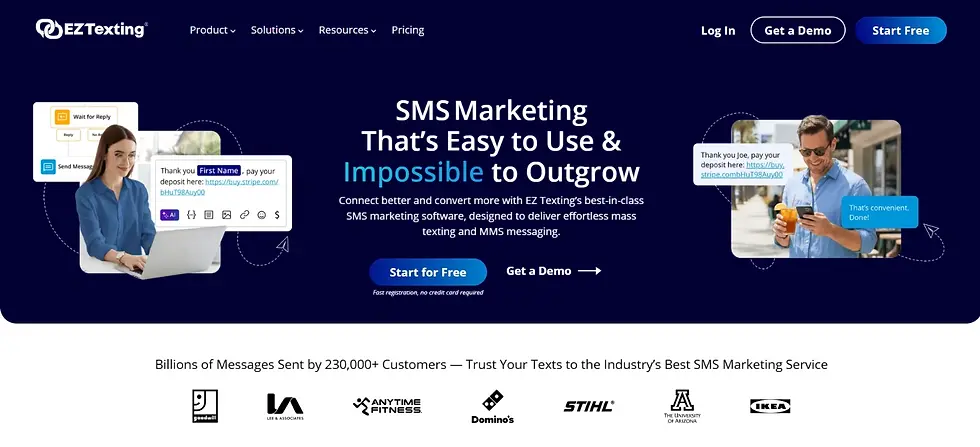
EZ Texting is a well-established, entry-level SMS marketing tool. It is strong at simple mass-texting campaigns and weak where regulated, team-based texting begins. Here is the fair picture, strengths and limits side by side.
PROS
Genuinely easy to use: The interface is beginner-friendly and campaign setup is fast. Non-technical marketers can launch a blast in minutes with no training.
Solid for one-way marketing: Its template library and list segmentation are built for promotional sends to opted-in consumer lists, which is exactly what it does well.
Reliable carrier delivery: Established telecom relationships mean campaign messages get delivered without you managing the plumbing.
CONS
Credits expire: Monthly credits lapse roughly monthly and annual credits after a year. Reviewers report forfeiting hundreds of dollars of unused credits.
Not HIPAA compliant: Paubox found no public BAA, and EZ Texting's own terms state texts and voice broadcasts are transmitted unencrypted. That is a liability for any healthcare or regulated sender.
Per-seat and telecom fees stack: You pay $10 per month per team member beyond the first, plus a $5 telecom fee on the entry plan.
Thin two-way collaboration: It is not built for a shared inbox, thread assignment, or the audit-ready workflows regulated client-facing teams need.
The takeaway is simple. EZ Texting suits simple marketing blasts. It does not fit growing, client-facing, or regulated teams that need compliance and team collaboration.
EZ Texting's Key Features, Broken Down
Here is what EZ Texting actually gives you, feature by feature, with a concrete example for each.
Keyword-Based Opt-In Campaigns
Subscribers text a keyword to a shortcode to join your list.
For example, a retail shop runs "Text SALE to 55512" on its window signage, and every opt-in flows straight into a promo list.
Mass Text Broadcasting
One-to-many sends push a single message to a segmented list.
For example, a nonprofit sends a last-minute volunteer call-out to 5,000 contacts in one broadcast.
Drip Campaigns and Scheduling
Automated sequences fire based on opt-in or a schedule.
For example, a gym sends a three-part welcome series over the first week after a new member signs up.
Automation matters more than most teams realize. Automated SMS flows account for just 7.6% of sends but generate 45.2% of SMS revenue, based on more than 183,000 customers.
Contact Segmentation
List filtering sorts contacts by tags or behavior.
For example, you separate active customers from lapsed ones so each group gets a different offer.
Integrations and API
EZ Texting connects to tools like Mailchimp, Constant Contact, and Zapier.
For example, a new Mailchimp subscriber syncs automatically into an EZ Texting list with no manual export.
EZ Texting Pricing: How Much Will It Cost?
EZ Texting sells message credits, not messages. That distinction is where the bill gets bigger than the sticker price.
Launch
Lowest monthly commitment, smallest credit allotment
Overage runs $0.04 per credit, the most expensive per-message rate of any plan
Carries a $5 per month telecom fee that higher plans waive
Best for: a solo user testing basic campaigns
Boost
More credits, overage drops to $0.035 per credit
Telecom fee waived
Best for: a small team running regular promotional sends
Scale
Largest credit allotment, overage at $0.03 per credit
Best for: higher-volume marketers who send consistently
Watch the credit math. Add an emoji and the message switches to a 70-character segment, so a short text can cost 2 credits. MMS costs 3 credits. And credits expire, monthly ones roughly monthly and annual ones after a year.
Now the seat math. Beyond the first user, you pay $10 per month per team member. So a three-person office on Launch pays $25 for the plan, $20 for two extra seats, and $5 in telecom fees, which is $50 per month before sending a single text.
That "cheapest" plan quietly becomes the most expensive way to run a small team.
10 Alternatives to EZ Texting: Which One Actually Fits?
Here are 10 alternatives worth comparing in 2026, ordered so the compliance-first pick leads. Start with the table, then read the tool that matches your use case. Ten tools, one table.
Tool | Best For | Starting At | HIPAA Compliant
|
Falkon SMS | Regulated, team-based two-way texting | $14.99/user/mo | Yes, with signed BAA (Pro) |
SimpleTexting | Broad SMB marketing | $39/mo | No |
SlickText | Ecommerce and loyalty | $29/mo | No |
Textedly | Affordable volume texting | $29/mo | No |
Salesmsg | Sales reps, HubSpot users | $25/mo + usage/seats | No |
TextMagic | Pay-as-you-go texting | $0.049/SMS | No |
Textline | HIPAA-native shared inbox | Contact vendor | Yes |
Text-Em-All | Mass notifications | $19/mo or credits | No |
Twilio | Developers and technical teams | $0.0083/segment | Via configuration |
Brevo | Combined email and SMS marketing | $0.0109/SMS (US) | No |
1. Falkon SMS

Best for: Healthcare practices, law firms, financial advisers, home care agencies, and other regulated teams that need business texting to hold up under a HIPAA audit or a FINRA or SEC review.
What it does: Falkon SMS text-enables the business number you already use, including a landline, VoIP line, toll-free number, or Microsoft Teams number, without porting or changing the voice service. Clients keep texting the office number already shown on your website and business cards. A shared inbox lets multiple team members handle that number together, assign threads, and move conversations through Open, In Progress, Follow-up, Resolved, and Closed statuses.
Pricing: Essential is $14.99 per user per month billed annually, or $17.99 monthly, with unlimited one-to-one texting and 250 group-texting credits. Pro is $24.99 per user per month billed annually and adds automation, analytics, scheduling, MMS, secure chat, HIPAA with a signed BAA, and FINRA and SEC archiving. There are no setup fees, annual billing saves up to 20%, and nonprofits receive a 10% discount.
Strengths: Compliance is part of the product foundation rather than a later add-on. Falkon is SOC 2 certified, supports role-based access and immutable audit trails, and can provide HIPAA messaging under a signed BAA on Pro. Add-on credits never expire and can move across numbers in the same organization. Falkon also handles 10DLC registration during onboarding.
Tradeoffs: Falkon is built around regulated, two-way, team-based conversations. A consumer brand whose main need is large promotional campaigns, ecommerce journeys, or combined email and SMS marketing may get a better fit from a marketing-first platform.
Why choose it over EZ Texting: Choose Falkon when texting is a compliance obligation, staff need to collaborate on one business number, or expiring credits are a recurring cost problem. It keeps the original office number, adds audit-ready controls, and gives regulated teams a more purpose-built operating model than a general SMS campaign tool.
Is Falkon SMS Right for Your Team?
See how Falkon SMS compares with EZ Texting and find the right fit for your business.
2. SimpleTexting

Best for: Small and midsize organizations that want a polished, general-purpose SMS marketing platform without building their own messaging stack.
What it does: SimpleTexting combines mass campaigns with two-way conversations. Teams can run scheduled campaigns, auto-replies, drip sequences, audience segments, data-collection flows, text-to-join keywords, and SMS or MMS from one interface. It supports unlimited contacts, opt-in forms and pop-ups, Mailchimp and Zapier connections, and text-to-landline so a business can add texting to an existing number without disrupting voice service. Incoming SMS is free, and the platform automatically detects and removes dead numbers rather than spending credits on them.
Pricing: The entry plan is $39 per month for 500 credits, or $398.40 when billed yearly. Extra credits are 5.5 cents each, a one-time $4 carrier-registration charge applies, and carrier pass-through fees are separate. One standard SMS segment uses one credit, extended messages use two, and MMS uses three. Unused monthly credits roll over only through the end of the following month; downgrading removes the rollover balance. SimpleTexting also lists optional user and dedicated-number charges.
Strengths: The feature set is broad but approachable. Every plan includes core campaign tools, reporting, live support, and unlimited contacts. Native Mailchimp and Zapier support covers common marketing workflows, while its API and done-for-you automation service can connect more specialized systems. Teams can trial the platform for 14 days without a credit card.
Tradeoffs: The credit model still rewards predictable monthly volume. Rollover is limited, MMS consumes more credits, and carrier fees sit outside the advertised subscription. It is designed for opted-in business and marketing communication, not as a regulated records system for protected health or financial-services conversations.
Why choose it over EZ Texting: Choose SimpleTexting when you want a similarly accessible campaign product but value its trial, two-way inbox, list-growth tools, integrations, and broader automation options. It is a close functional alternative rather than a different category of product, so compare total credits, add-ons, and carrier fees against your actual sending pattern.
3. SlickText
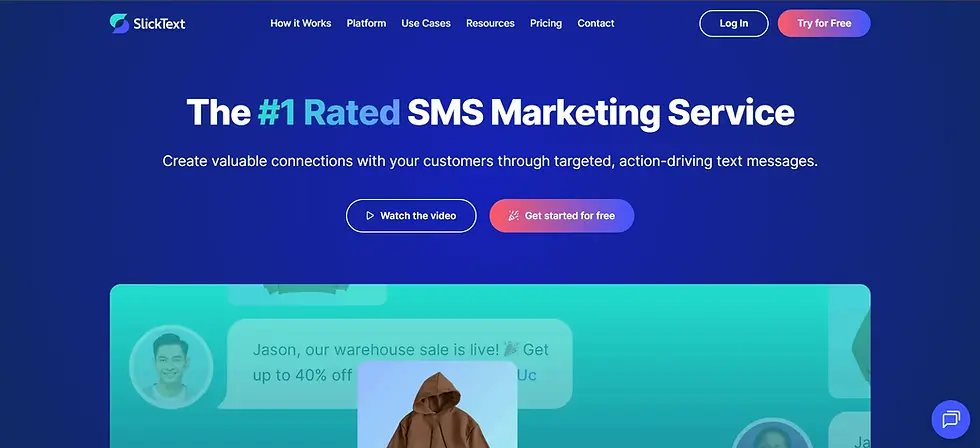
Best for: Consumer brands, retailers, restaurants, and ecommerce teams that use SMS for promotions, loyalty, list growth, and behavior-triggered campaigns.
What it does: SlickText is a marketing-first platform for mass SMS and MMS, text-to-join keywords, tap-to-join links, QR-code and web-form opt-ins, coupons, loyalty programs, and automated customer journeys. Its segmentation can use contact data and real-time behavior, while Shopify-focused workflows can react to browsing, product views, and cart status. Native connections include tools such as Shopify, Mailchimp, and Salesforce, with thousands more available through Zapier, Make, and its API. Standard opt-out requests are processed automatically.
Pricing: Plans begin at $29 per month for 500 credits. Published tiers rise through $49 for 1,000, $79 for 2,000, $129 for 3,500, $169 for 5,000, $319 for 10,000, $579 for 25,000, and $939 for 50,000 credits. One 160-character SMS segment uses one credit, while an MMS can carry up to 1,600 characters and uses three credits. Carrier fees are passed through separately. Annual plans include two free months of credits, and unused credits roll for one billing term.
Strengths: SlickText gives marketers detailed audience and ecommerce tools without requiring an engineering team. Unlimited custom contact fields support precise segments, and all plan sizes include integrations and workflows. The vendor also emphasizes direct carrier relationships, registration help, proven opt-in methods, and live support. A 14-day trial unlocks every feature without requiring a credit card.
Tradeoffs: This depth is concentrated in subscriber marketing. It is less suited to case-based client communication, shared ownership of sensitive conversations, or regulated retention and audit requirements. Costs also rise with message volume, MMS usage, and carrier fees, so a high-frequency program needs a realistic segment count.
Why choose it over EZ Texting: Choose SlickText when your SMS strategy depends on ecommerce behavior, sophisticated segmentation, loyalty, or promotional automation. It is especially compelling when Shopify and customer-lifecycle workflows matter more than a basic blast-and-reply tool. Regulated service teams should look elsewhere.
4. Textedly
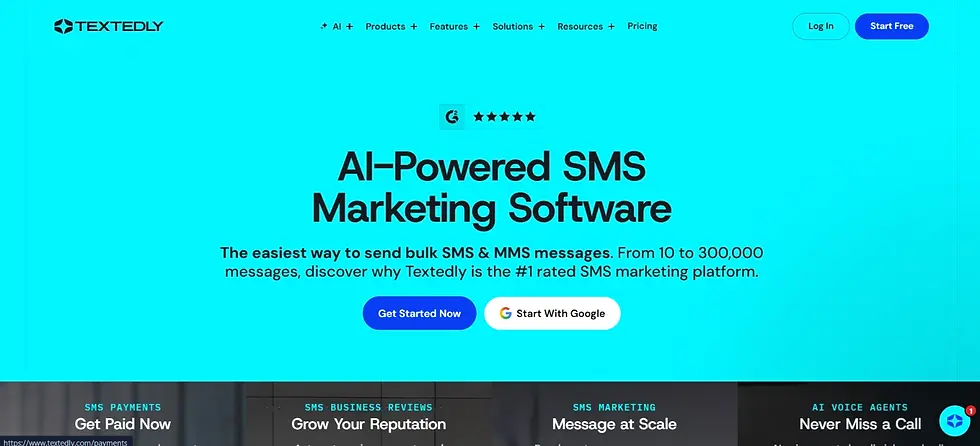
Best for: Marketing and operations teams that want mass texting, an omnichannel inbox, and a wide feature set at a relatively low starting price.
What it does: Textedly supports scheduled SMS and MMS campaigns, text-to-join keywords, automatic replies, unlimited contact storage, surveys, link tools, and long-form messages up to 1,600 characters. Its inbox brings conversations into one place, lets teams add and assign teammates, prioritize threads, and build response automations. It can also receive images, videos, and PDF files by MMS. Current features extend beyond basic campaigns to payment requests powered by Stripe, Google review requests, AI writing and agents, voice services, and contact enrichment. Connections include Mailchimp, Shopify, Salesforce, Slack, Zapier, and a public API.
Pricing: Textedly says plans start at $29 per month and scale by monthly message and keyword limits, with inbound messages free and no long-term contract. Paying annually adds 20% more texts per month. All plans include the full product feature set, while higher tiers mainly increase volume. Because the platform counts messages by credits and supports high-volume plans, buyers should confirm the exact allowance, keyword limit, carrier charges, and overage price for the tier they are considering.
Strengths: Few entry-level platforms bundle this many channels and workflow tools. Unlimited contacts avoid list-size penalties, every plan gets core features, and the shared inbox gives teams more than a one-way broadcast console. Native compliance aids cover opt-in, opt-out, carrier guidelines, and registration workflows. Support is available seven days a week.
Tradeoffs: Breadth can be more than a team needs, and several newer AI, voice, enrichment, and payment features may not be relevant to a simple alert program. Carrier-compliance tools are not the same as HIPAA or financial-services recordkeeping. Teams handling protected or regulated content should verify security, contractual, retention, and BAA requirements independently.
Why choose it over EZ Texting: Choose Textedly when you want a low starting price plus an inbox, integrations, rich inbound MMS, and automation without paying for a separate feature tier. It is best for teams that will use that wider toolkit; a bare-bones sender should compare the final plan and carrier costs first.
5. Salesmsg
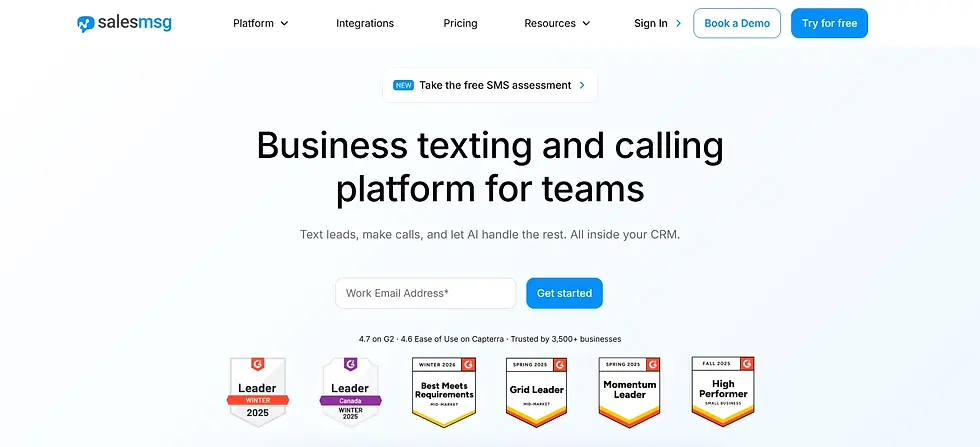
Best for: Sales, service, and revenue teams that work inside a CRM and need one-to-one conversations, shared inboxes, broadcasts, and follow-up automation around leads.
What it does: Salesmsg gives teams local business numbers and private or shared inboxes for SMS, MMS, images, video, and file attachments. Reps can assign replies, use auto-responses, send personalized broadcasts to an entire list or a segment, and build drag-and-drop automations from templates. Keywords can add contacts or trigger instant responses. CRM context, history, and notes stay close to the conversation, and the product works across web, mobile, and a Chrome extension. Its published integrations include HubSpot, Salesforce, ActiveCampaign, Pipedrive, and Zapier, and the platform says each message can sync back to the connected CRM.
Pricing: The published entry plan is $25 per month and includes message credits, with additional seats at $10 per month. Salesmsg says SMS uses one credit, MMS uses two, and credits start at four cents with volume discounts on higher plans. Its pricing page also shows larger plans, including a $277 per month tier, so the right total depends on seats, monthly credits, numbers, and calling needs. Buyers should use the current calculator or quote rather than compare only the headline subscription.
Strengths: CRM-native workflow is the main advantage. Reps can see and act on replies without losing the deal context, while shared ownership, assignments, broadcasts, and automation support both individual follow-up and scaled outreach. Salesmsg also states that broadcasts have no contact-count limit and delivery is managed around carrier guidelines and 10DLC registration. It lists secure messaging and calling features that support HIPAA compliance.
Tradeoffs: It is designed around North American revenue workflows rather than a broad international marketing footprint. Seat and usage charges can compound as a team grows, and CRM depth matters only if your organization uses one of its supported systems. Any regulated team should verify plan-level security, contracts, and retention requirements for its own use case.
Why choose it over EZ Texting: Choose Salesmsg when SMS belongs inside the sales process, not beside it. Its CRM sync, rep inboxes, assignment, and automated follow-up make it a better fit for lead conversion and customer conversations than a campaign-first texting platform.
6. Textmagic

Best for: Organizations with irregular volume that prefer transparent pay-as-you-go communication rather than committing to a fixed monthly bundle of expiring message credits.
What it does: Textmagic combines bulk SMS, two-way texting, automation workflows, a shared team inbox, email campaigns, an omnichannel web chat widget, dedicated numbers and sender IDs, and API or integration access. Contacts and users are unlimited. Teams can schedule campaigns, use templates and AI-assisted writing, manage incoming replies, and add voice features such as call forwarding. It can also connect a number from another CPaaS provider for some sending scenarios, which may lower the platform-side message rate but changes the feature and number setup.
Pricing: For the United States, Textmagic lists 1,000 SMS at $49, equivalent to $0.049 per standard 160-character message segment. A dedicated local or toll-free number is $10 per month after the first free month. MMS is $0.08 per sent or received message, and 10DLC campaign registration renews at $10 per month after the initial free month. Email is $0.006 each, email and phone validation are $0.04 per lookup, and voice rates vary by direction. Connected CPaaS numbers can send one-way SMS at $0.01 per segment, but texts from Textmagic numbers use the standard rate.
Strengths: The model is easy to align with uneven usage: buy credits and apply them across SMS, email, and other services rather than choosing a large recurring message tier. The feature set goes beyond bulk sending, with unlimited users, a shared inbox, workflow automation, APIs, and multiple channels. Published unit prices make it easier to estimate a small or occasional program.
Tradeoffs: Pay-as-you-go does not mean fee-free. Numbers, 10DLC registration, MMS, voice, lookups, and long messages add to the total. At steady high volume, a bundled plan elsewhere may be more economical. Textmagic supplies compliance tools, but it is not positioned as a regulated archival system for HIPAA, FINRA, or SEC communication.
Why choose it over EZ Texting: Choose Textmagic when monthly volume swings, you dislike losing unused subscription credits, or you want SMS and email under a usage-based balance. Model the complete cost, including number and registration fees, before deciding.
7. Textline

Best for: Support, operations, logistics, and healthcare teams that need collaborative two-way texting with assignments, conversation management, and a HIPAA-capable plan.
What it does: Textline is built around team conversations rather than only marketing blasts. Its shared inbox lets staff receive and manage texts together, route work, and maintain an operational view of customer communication. Marketing and operations plans include message credits, with the ability to buy add-ons. Organizations can use a toll-free number or a registered 10DLC number. For healthcare, Textline offers HIPAA-oriented controls and states that it enters Business Associate Agreements on qualifying HIPAA plans, with safeguards for protected health information.
Pricing: Textline's pricing depends on plan and user count rather than a single public flat rate. Its published structure shows a 600-credit minimum on one plan and 2,000 on another. Add-on message credits cost $0.03 each and are purchased in advance. Using a 10DLC number adds a $15 monthly campaign fee, while Textline says toll-free numbers currently do not carry that monthly registration charge. Prospects should request or calculate the full price using users, included credits, number type, and expected overage volume.
Strengths: Team workflow is central to the product. That makes it better suited to customer service, dispatch, and ongoing conversations where a reply needs an owner than a basic campaign console. The availability of a HIPAA plan and BAA is meaningful for healthcare organizations, and the pricing model at least separates included credits, add-ons, and registration charges so buyers can ask the right questions.
Tradeoffs: The lack of one universal headline price makes fast comparison harder. Add-on credits and 10DLC fees can increase the total, and healthcare readiness does not automatically satisfy financial-services retention rules. FINRA- or SEC-regulated teams should confirm message immutability, retention, supervision, export, and archival integrations before adopting it.
Why choose it over EZ Texting: Choose Textline when the main job is managing inbound and outbound customer conversations across a team, especially in support or healthcare. Its inbox-led workflow and HIPAA option are stronger differentiators than bulk campaign volume.
8. Text-Em-All
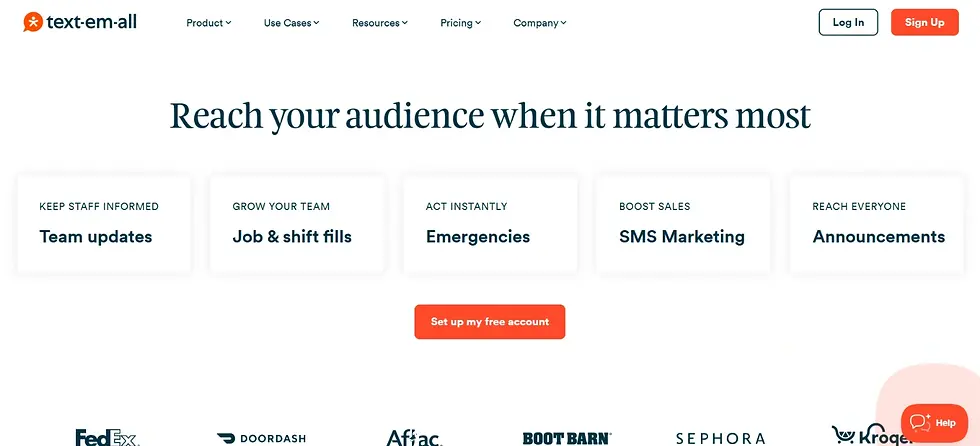
Best for: Schools, nonprofits, congregations, property managers, HR teams, and community organizations that primarily send reminders, announcements, staffing messages, and urgent notifications at scale.
What it does: Text-Em-All specializes in mass text and automated voice broadcasts. Teams can upload and organize contacts, build templates, schedule messages, personalize content, and monitor replies and delivery. The service supports both a pay-as-you-go credits model and a monthly plan, letting occasional senders avoid a subscription while regular broadcasters choose a predictable contact-based tier. Its use cases center on dependable outreach rather than complex marketing journeys or a sales CRM.
Pricing: Pay-as-you-go starts with 25 free credits, then can cost as little as five cents per credit depending on the amount purchased. Monthly pricing starts at $19 and is based on the number of unique contacts reached within the month: $19 covers 1-50 contacts, $39 covers 51-100, $69 covers 101-200, and published tiers continue upward to $599 for 2,001-2,500 contacts. The vendor's own example shows that frequent sends to the same group can make the monthly plan cheaper than paying by message credits. Buyers should choose using both audience size and send frequency.
Strengths: The two billing models make the product unusually adaptable for notification programs. Voice and text in one service help reach people who may not respond to one channel. Templates, scheduling, contact management, personalization, reporting, and replies cover the practical needs of reminders and alerts without forcing the team into an ecommerce or developer platform. The published contact tiers make recurring group communication easy to estimate.
Tradeoffs: This is primarily a broadcast and notification product, not a full customer-conversation workspace. It lacks the marketing depth of behavior-triggered ecommerce tools and is not positioned as a regulated archive. A large contact list that is messaged only once may fit the credits plan, while repeated sends can favor monthly pricing, so choosing the wrong model can waste money.
Why choose it over EZ Texting: Choose Text-Em-All when your priority is clear, dependable voice and text notification with billing that can match either occasional or recurring outreach. It is a focused alternative for alerts, not an all-purpose replacement for every sales or marketing workflow.
9. Twilio
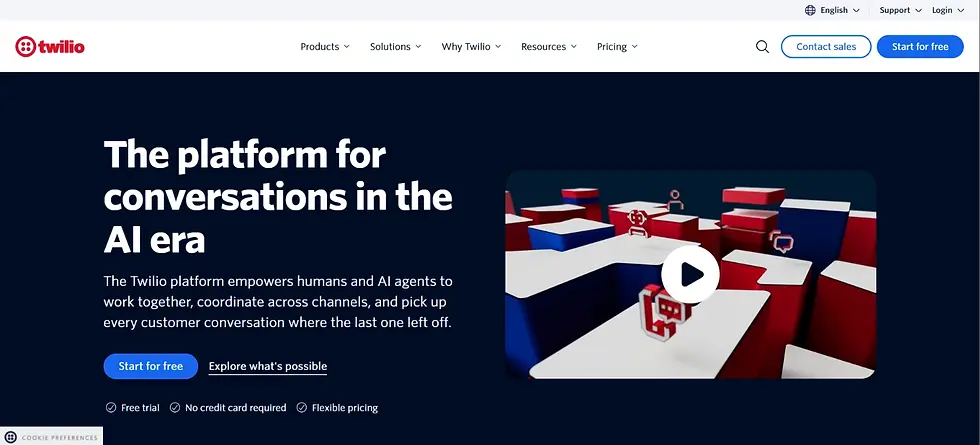
Best for: Product and engineering teams that want programmable messaging infrastructure and are prepared to design the application, workflows, compliance processes, and user experience themselves.
What it does: Twilio provides APIs for SMS, MMS, RCS, WhatsApp, and multichannel conversations. Developers can send and receive messages, lease local, toll-free, or short-code numbers, add scheduling and link tracking through an engagement suite, and combine messaging with authentication, voice, customer data, or other Twilio services. The programmable model gives a team control over routing, event handling, data storage, consent logic, and the interface its staff or customers use. Twilio is the communications layer, not a ready-made campaign dashboard.
Pricing: US long-code and toll-free SMS starts at $0.0083 for each inbound or outbound segment, before carrier fees. US MMS is priced separately, and fees vary by number type and direction. A leased long code starts at $1.15 per month and a toll-free number at $2.15; short codes cost far more. Twilio also passes through carrier charges, such as per-message fees from AT&T, T-Mobile, and Verizon. Optional tools can add per-message charges, including $0.015 for the Engagement Suite after the first 1,000 monthly and $0.015 for the Compliance Toolkit.
Strengths: Flexibility is the point. Technical teams can build exactly the messaging experience they need, support multiple channels, integrate proprietary systems, and scale without being constrained by an off-the-shelf UI. Published unit pricing is granular, and the platform supports different sender types and high-throughput configurations. For a software product, custom operations platform, or unusual integration, that control can outweigh setup effort.
Tradeoffs: Twilio requires engineering, product, and operational ownership. The low base SMS rate is only one part of cost; phone numbers, carrier pass-throughs, registration, optional features, storage, monitoring, support, and development all matter. Your team also owns consent, opt-out behavior, workflow safety, records, and the employee-facing interface unless another product supplies them.
Why choose it over EZ Texting: Choose Twilio when EZ Texting's fixed application is the limitation and you need infrastructure to build a custom system. Do not choose it merely for the headline per-segment price if you actually need a ready-to-use marketing or shared-inbox product.
10. Brevo Marketing Platform

Best for: Marketing teams that want email, SMS, and automation in one customer platform rather than operating a separate texting-only system.
What it does: Brevo combines email campaigns, SMS marketing, contact management, audience segmentation, and multichannel automation. Marketers can build SMS campaigns from the same contact database used for email, personalize messages with contact attributes, schedule delivery, and track campaign results. The broader platform also supports forms, transactional communication, sales and service products, and automation journeys, so a team can coordinate channels without maintaining separate lists and logic. SMS availability and sender rules vary by destination country.
Pricing: Brevo offers a free core marketing tier for email and lets customers add SMS on a pay-as-you-go basis. For the United States, its published SMS rate starts at $0.0109 per message credit and varies by destination. Brevo says there are no monthly minimums, no contract, and no expiration date for SMS credits. Credit usage can vary with message type, length, character set, and destination, so international or Unicode-heavy programs should use Brevo's calculator rather than multiply only the starting US rate. Paid platform plans add more email volume and features separately.
Strengths: The unified contact database and automation builder are the clearest benefits. A marketer can coordinate email and SMS around the same customer journey, segments, and campaign calendar. Pay-as-you-go SMS avoids committing to a separate monthly texting bundle, and non-expiring SMS credits reduce the risk of losing a prepaid balance. This is useful for teams whose text volume is seasonal or secondary to email.
Tradeoffs: Brevo is marketing-first, not a dedicated shared inbox for regulated client conversations. SMS costs and availability differ by country, and the total platform price may include a paid email plan plus SMS credits. Teams needing local-number conversations, case assignment, HIPAA BAAs, financial-services archiving, or a developer-controlled messaging layer should evaluate a more specialized tool.
Why choose it over EZ Texting: Choose Brevo when the strategic goal is to consolidate email and SMS automation, reuse one contact database, and pay for text volume as needed. It is a stronger cross-channel marketing alternative, but not the right substitute for compliance-led or conversation-led business texting.
Ready to Move Beyond EZ Texting?
If expiring credits, per-seat costs, or limited team collaboration are holding your business texting back, Falkon SMS gives your team a more flexible way to communicate. Text-enable your existing business number, manage conversations from a shared inbox, and keep your messaging ready for regulated workflows.
How Falkon SMS Makes the Switch Easier
If you left EZ Texting over expiring credits, missing compliance, or per-seat fees, Falkon SMS was built to close all three gaps. Here is how.
It kills the credit-expiry problem: Falkon SMS add-on credits never expire and are transferable across numbers in your organization. The money you spend stays yours, which is the opposite of forfeiting hundreds of dollars in lapsed credits.
It makes compliance the foundation, not an add-on: The Pro plan at $24.99 per user per month includes HIPAA-compliant messaging with a signed BAA, FINRA and SEC archiving, immutable audit trails, role-based access, and SOC 2 Type I certification. PHI is encrypted in transit and at rest, and Secure Chat adds PIN-protected sessions with documents sent through expiring secure links. That combination directly answers the EZ Texting gap where texts move unencrypted with no BAA.
It text-enables the number you already own: Turn your existing landline, VoIP line, toll-free number, or Microsoft Teams number into a texting line with no hardware and no porting, and Falkon SMS handles 10DLC registration during onboarding. Your team works from a shared inbox, assigns threads, tags conversations, and can group broadcast to up to 2,000 contacts per send.
One honest reality check. Falkon SMS is built for regulated, two-way, team-based texting, not for high-volume ecommerce marketing blasts. If your primary need is pure ecommerce SMS and email automation, a marketing-first tool like Brevo or Omnisend genuinely fits better.
But if texting is a compliance obligation, the math is straightforward.
Essential starts at $14.99 per user per month billed annually with unlimited 1-to-1 texting and 250 group texting credits, there are no setup fees, and nonprofits get 10% off. You can start a free trial with no credit card required, or book a demo.
Frequently Asked Questions
Is EZ Texting HIPAA compliant?
No. Paubox found EZ Texting has no publicly available Business Associate Agreement, and its own terms state text messages and voice broadcasts are transmitted unencrypted. Sending protected health information through it violates HIPAA, which carries fines up to $1.5 million per violation category annually. Use a platform with a signed BAA instead.
Why do businesses leave EZ Texting?
Three reasons dominate. Credits expire and reviewers report forfeiting hundreds of dollars in unused balances. Per-seat fees of $10 per user plus a $5 telecom fee stack fast on small teams. And its two-way conversation and collaboration tools are thin, which pushes growing, client-facing teams toward shared-inbox platforms.
Do EZ Texting credits expire?
Yes. Monthly credits lapse roughly monthly, and annual credits expire after a year. Reviewers report losing hundreds of dollars in unused credits as a result. If credit expiry frustrates you, look at platforms like Falkon SMS, whose add-on credits never expire and are transferable across numbers in your organization.
Is there a cheaper alternative to EZ Texting?
Yes, several. TextMagic is pay-as-you-go at $0.049 per SMS with no monthly commitment. Falkon SMS Essential is $14.99 per user per month billed annually with unlimited 1-to-1 texting and no expiring credits. Compared to EZ Texting Launch at $25 plus seat and telecom fees, both can cost less for a small team.
What is the best EZ Texting alternative for higher volume?
It depends on your use case. For marketing volume, SlickText or SimpleTexting scale to 50,000-credit plans. For regulated-industry volume that needs compliance, Falkon SMS Pro supports group broadcast to up to 2,000 contacts per send, with HIPAA, a signed BAA, and FINRA and SEC archiving built in.
The Bottom Line on EZ Texting Alternatives in 2026
EZ Texting works for what it was built for: simple, one-way marketing blasts to opted-in consumer lists. Its interface is easy and delivery is reliable.
But its credit model, per-seat fees, and missing HIPAA compliance make it the wrong fit for growing teams and any regulated sender. An estimated 75% of medical providers are expected to use HIPAA-compliant texting apps by 2026, and EZ Texting is not one of them.
No single tool wins every scenario. The right pick depends on whether compliance, volume, or ecommerce automation is your primary driver.
If your team is in healthcare, legal, or finance, where texting is not optional but a compliance obligation, Falkon SMS offers a free trial with no credit card required, or you can book a demo.
Ready for an EZ Texting Alternative?
Switch to Falkon SMS for flexible business texting with non-expiring credits and team collaboration.


